Environmental Defense Fund’s latest blog post examines why reducing livestock methane is considered one of the most significant near-term opportunities for climate action. The article discusses available methane-reduction solutions, the need for approaches tailored to different farming systems, and the support farmers need to adopt these practices successfully.
We are excited to announce the Round 7 recipients of Climate, Food and Farming – Global Research Alliance on Agricultural Greenhouse Gases Development Scholarships (CLIFF-GRADS). These PhD candidates from low- and middle-income countries have been selected from a large and highly competitive applicant pool, reflecting their outstanding qualifications and strong potential to advance agricultural climate research.
During 2026 and 2027, these fellows will undertake applied research focused on quantifying and mitigating agricultural greenhouse gas emissions, contributing to more sustainable food systems.
The 40 Round 7 CLIFF-GRADS fellows represent 21 countries from Asia, Africa, Latin America, and the Caribbean. They will carry out research placements at 33 host institutions worldwide.
CLIFF-GRADS offers short-term research placements of 4 to 6 months. These placements give early-career scientists access to specialized equipment, software, and international expertise not available at their home institutions. Fellows contribute to cutting-edge research in areas such as enteric methane, rice systems, soil emissions, and blue carbon ecosystems.
Please follow this LINK to learn about the scholars and research projects they’ll be part of.
One Health in agrifood systems: Recognition for good practices, success stories and innovations in applying the One Health approach
As part of this year’s Global Conference for Actions on One Health in Agrifood Systems, FAO will celebrate best practices and outstanding innovations advancing the One Health approach across agrifood systems. Through this recognition, we will shine a spotlight on pioneering efforts from stakeholders across agrifood systems – showcasing impactful solutions and inspiring future action toward integrated, inclusive, sustainable, and health-oriented agrifood systems.
Objectives
This recognition aims to promote successfully implemented good practices and outstanding innovations in One Health in agrifood systems that have demonstrated significant measurable impact, and to inspire continued innovation through global stakeholder collaboration.
Scope
The Global Conference will recognize practices, success stories and solutions that represent significant advancements or innovations in One Health approaches and sustainable livestock transformation across the entire value chain, successfully implemented at scale in villages, communities, and cities across the world.
These may include new technologies, systems, practices, or solutions that improve efficiency and support action on One Health in agrifood systems and the sustainable transformation of the livestock value chain, encompassing food security, greenhouse gas mitigation, animal health and welfare, antimicrobial resistance, sustainable livestock farming systems, Indigenous Peoples and pastoralist knowledge systems, women and girls empowerment, capacity development for small-scale producers, finance, post-processing, and policy support.
Eligibility
The conference welcomes applications from institutions, international and regional organizations, academic or research entities, civil society groups, and private sector entities. Applications from women, youth, and Indigenous Peoples are particularly encouraged. FAO employees are not eligible to apply.
Selection process
An international panel of experts nominated by FAO will assess the applications, with attention to inclusive and balanced representation across regions, genders, expertise fields, disciplines, and stakeholder groups.
Evaluations will be based on the following criteria:
Impact and practical application: Demonstrated real-world results and effectiveness.
Innovation and originality: Novelty and uniqueness of the proposed approach.
Inclusivity and social impact: Contribution to gender equality, youth engagement, Indigenous communities’ involvement.
Scalability and replicability: Potential for adoption and implementation across diverse contexts and regions.
Sustainability: Contribution to long-term resilience in agrifood systems.
Recognition, demonstration and ceremony
Recipients will receive official recognition at the FAO Global Conference for Actions on One Health in Agrifood Systems, to be held from 21–23 September 2026 at FAO headquarters. A dedicated technical presentation session and innovation pitch talk will be organized as a special event.
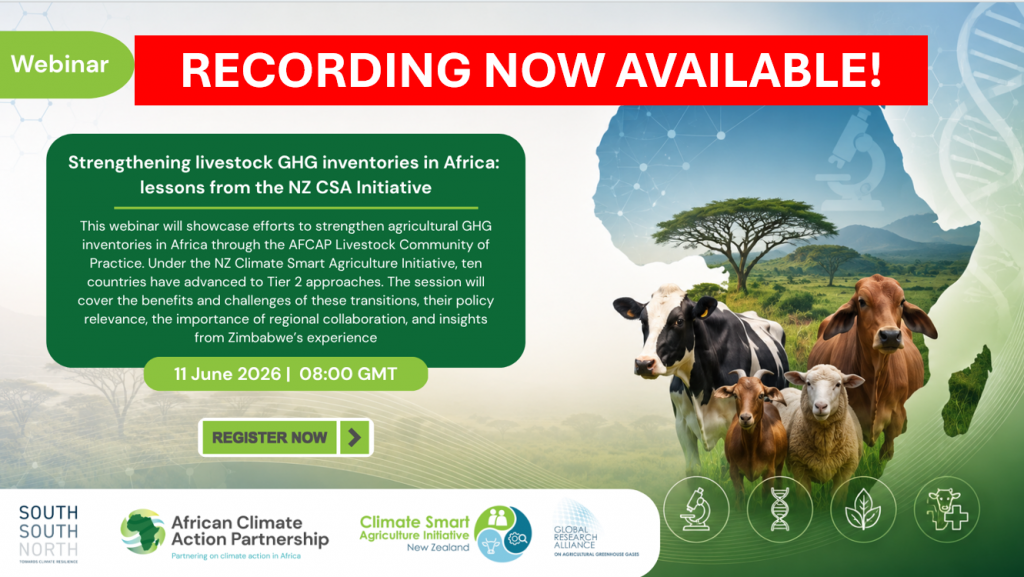
The Global Research Alliance (GRA), the African Climate Action Partnership (AfCAP), and the Government of New Zealand co-hosted this webinar to showcase the achievements of the New Zealand Climate Smart Agriculture (NZCSA) Initiative. The session highlights the initiatives key capability-building efforts across Africa focused on improving agricultural greenhouse gas (GHG) inventories, and the important role of the AfCAP Livestock Community of Practice. Through the NZCSA Initiative, technical work in ten countries has progressed beyond default emissions estimates to more advanced Tier 2 methodologies, enabling more accurate and country-specific data.
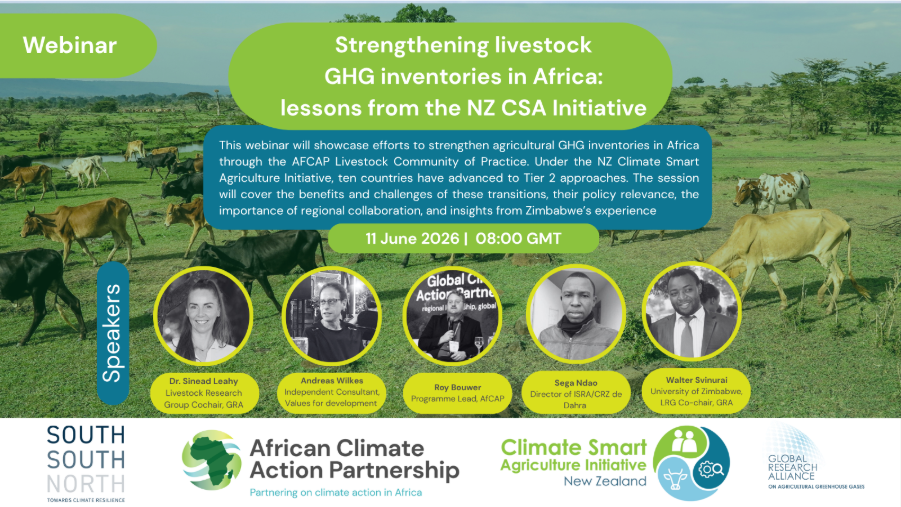
The Speakers
Moderator: Sinead Leahy (Livestock Research Group Co-Chair, GRA) Opening remarks and Context setting
Speaker 1: Andreas Wilkes (Independent consultant, Values for Development Ltd) NZCSA inventory improvement approach and impact across 10 countries
Speaker 2: Walter Svinurai (University of Zimbabwe) Zimbabwe’s progress, policy relevance and regional connections
Speaker 3: Séga Ndao (Director of ISRA/CRZ Dahra – AfCAP/Livestock CoP) Regional Inventory improvement and bilateral exchanges in West Africa
Speaker 4: Roy Bouwer (Programme Lead, South South North) Regional collaboration in Southern and Eastern Africa and the AfCAP Livestock CoP
A video recording of the webinar are now available to view HERE
We’re proud to share the session recordings from the 2026 New Zealand Agriculture and Climate Change Conference!
The recordings cover a wide range of topics, from the latest research and innovation to practical conversations about the opportunities and challenges ahead for reducing agricultural emissions in Aotearoa New Zealand.
The Global Research Alliance (GRA) & the African Climate Action Partnership (AfCAP) cordially invite you to register for our upcoming webinar on “Strengthening livestock GHG inventories in Africa: Lessons from the NZ CSA Initiative”. This engaging session will bring together inventory and livestock experts, national inventory compilers, researchers, government officials, and development partners involved in agricultural GHG measurement and reporting to gain practical insights into how African countries are strengthening agricultural GHG inventories through Tier 2 approaches. Attendees will also learn about the benefits and challenges of these transitions, their policy relevance, the value of regional collaboration, and hear directly from Zimbabwe’s experience.
Webinar Overview:
This session will showcase key capability-building activities in Africa, centred on improving agricultural GHG inventories, and the role of the AFCAP Livestock Community of Practice. Under the NZ Climate Smart Agriculture (CSA) Initiative, technical work in ten countries has moved beyond default emissions estimates to full Tier 2 approaches. The webinar will highlight the practical benefits and challenges of Tier upgrades, their policy relevance, the value of regional collaboration through AFCAP, and insights from the Zimbabwean government.
Event Details
Title: Strengthening livestock GHG inventories in Africa: Lessons from the NZ CSA Initiative
We are excited to announce the upcoming workshop to be held in Clermont-Ferrand on June 2, 2025!This event will bring together experts and participants from various fields of rumen microbiota to explore cutting-edge topics and share knowledge in a collaborative environment. With a focus on hands-on learning and interactive discussions, the workshop promises to provide valuable insights and foster connections among professionals. This workshop is being held alongside the 14th International Gut Microbiology Symposium - 3-5 June 2025. Meet our keynote speakers:Dr Nikola…
The Integrated Microbial Genomes & Microbiomes system (IMG/M) supports the annotation, comparative analysis, and distribution of microbial genome and microbiome datasets. It includes over 200,000 diverse publicly available datasets encompassing 150,000 isolate genomes, 23,000 metagenome-assembled genomes (MAGs), and 40,000 metagenomes along with curated environmental and other metadata to enable comprehensive comparative analysis. Importantly, IMG/M provides data and tools via graphical user interface (GUI), so no programming knowledge and no dedicated compute infrastructure is required to perform computational analysis. IMG/M user…
The webinar intends to give an overview of our knowledge about current manure management practices in sub-Saharan Africa and their impacts on GHG and ammonia emissions and other externalities (e.g., leaching, health hazards). The discussions after the presentation will be about identifying pressing knowledge gaps linked to manure and ideas for collaboration. The aim for collaboration could be to explore opportunities for joint in-depth analysis of the current manure management systems and how efficiently manure is recycled to fertilize soil…
June 25, 2025 @ 8:00 am - June 28, 2025 @ 5:00 pm EEST
Save the date & register! We are delighted to invite you to the first edition of the Latin American and Caribbean Soil Carbon Research Symposium (LAC Soil Carbon)! Over four days, whether you are a researcher, student, or soil and environment expert, come to exchange ideas and discuss the regional and global challenges linked to promoting sustainable agricultural practices and preserving soil health 🌻🚜 Co-organised by the Soil Carbon International Research Consortium (IRC) and the international “4 per 1000” Initiative, the Symposium is a unique opportunity to gain knowldege on organic…
Episode 1: Ecosystem Safeguarding – Land and Water Perspectives Expect an open, conversational format as our guest experts unpack questions like: We’ll also explore practical solutions and system-wide strategies for maintaining ecosystem health, circular nutrient flows, and long-term sustainability. Featuring Special Guests: Register HERE
Join us for the launch of the MiLCA Protocol – a science-based framework to help the dairy and broader agricultural sectors evaluate and report on emission-reducing technologies. Hear from technical experts how MiLCA supports credible, science-based integration of mitigation technologies into lifecycle assessment. Choose the webinar time that suits you best! 📅 Webinar 1: Wed 13 August 2025, 10:00 AM NZT Chair: Harry Clark, Ag Emissions CentreIndustry Speaker: Andrew Fletcher, FonterraTechnical Presentation: Aaron Simmons, NSW DPI REGISTER HERE 📅 Webinar 2: Thurs 21 August 2025, 8:00…
October 5, 2025 @ 8:00 am - October 9, 2025 @ 5:00 pm EAT
At the 9TH GGAA, you’ll have the chance to delve into cutting-edge research, connect with experts and participate in lively discussions covering GHG mitigation, measurement techniques, advanced modelling, and on-farm practices. You’ll get to discover insights into policies addressing agricultural impacts on GHGs and stay updated on the latest scientific developments. There will also be field visits you can join to national parks, farms, and rangeland sites, including ILRI’s Kapiti Conservancy and Research Station on the outskirts of Nairobi. Dates for the conference are…
Gaseous emissions from agriculture contribute significantly to greenhouse gas (GHG) and ammonia in the atmosphere, and climate change and pollution of aquatic ecosystems. Reliable data from measurements and studies is needed for the development of technology and management practice to reduce emissions, calculate emission inventories (e.g. IPCC) and provide valid data to assess emissions reduction for carbon credit trade. Three researchers with extensive experience in measuring gas emission from farming will present the great potential in the use of the chamber…
Accelerating Robust and Scalable Measurement, Reporting and Verification Wednesday, February 25, 2026 Time: 6:00 - 8:00 am Washington, DC | 12:00 pm Paris | 4:30 pm Mumbai | 5:00 pm Dhaka | 6:00 pm Jakarta, Phnom Penh, Hanoi | 7:00 pm Beijing, Manila Join via ZOOM RSVP & ADD TO CALENDAR Background: The World Bank Group is hosting a webinar series, Measurement Matters: Sustainable Pathways for Next Generation Rice, to engage country participants and partners in the Scaling Next Generation Rice Impact Program. The series is open to…
This webinar presents the findings of a global meta-analysis examining the factors that regulate the effectiveness of biological nitrification inhibition (BNI) in reducing nitrous oxide (N₂O) emissions from agricultural systems. BNI is a plant-mediated process in which certain metabolites inhibit soil nitrifying microorganisms, slowing the conversion of ammonium to nitrate and potentially reducing N₂O emissions. By synthesizing results from 23 published studies, this analysis evaluates the influence of genetic, environmental, and management factors on cumulative N₂O emission reduction. The results highlight…
Methane (CH₄) emissions from ruminant livestock remain a key challenge for agricultural greenhouse gas mitigation. Increasing attention is being given to the role of the rumen microbiome in influencing methane production, and the potential to leverage microbial pathways as part of mitigation strategies. Part of the 2025 Ag Emissions Centre ‘State of Science’ Webinar Series, this session brings together expertise from Teagasc and the Ag Emissions Centre, organisations at the forefront of agricultural greenhouse gas research and innovation. This webinar will explore the emerging…
We are pleased to announce the International Conference on “Future-Ready Farming: Climate-Smart and Resilient Agricultural Solutions (ICFRF-2026)” to be held during 8–10 July 2026 at TNAU, Coimbatore, India. The conference aims to bring together students, researchers, academicians, Industry professionals, policymakers, and development practitioners to share knowledge and innovations in building climate-smart and resilient agricultural systems. Major of the conference includes: Theme 1: Seamless Climate Intelligence for Risk-Ready Farming Theme 2: Innovative Crop Improvement Approaches for Climate-Resilience Theme 3: Digital and Nature-Based Solutions…