We are excited to announce the Round 7 recipients of Climate, Food and Farming – Global Research Alliance on Agricultural Greenhouse Gases Development Scholarships (CLIFF-GRADS). These PhD candidates from low- and middle-income countries have been selected from a large and highly competitive applicant pool, reflecting their outstanding qualifications and strong potential to advance agricultural climate research.
During 2026 and 2027, these fellows will undertake applied research focused on quantifying and mitigating agricultural greenhouse gas emissions, contributing to more sustainable food systems.
The 40 Round 7 CLIFF-GRADS fellows represent 21 countries from Asia, Africa, Latin America, and the Caribbean. They will carry out research placements at 33 host institutions worldwide.
CLIFF-GRADS offers short-term research placements of 4 to 6 months. These placements give early-career scientists access to specialized equipment, software, and international expertise not available at their home institutions. Fellows contribute to cutting-edge research in areas such as enteric methane, rice systems, soil emissions, and blue carbon ecosystems.
Please follow this LINK to learn about the scholars and research projects they’ll be part of.
One Health in agrifood systems: Recognition for good practices, success stories and innovations in applying the One Health approach
As part of this year’s Global Conference for Actions on One Health in Agrifood Systems, FAO will celebrate best practices and outstanding innovations advancing the One Health approach across agrifood systems. Through this recognition, we will shine a spotlight on pioneering efforts from stakeholders across agrifood systems – showcasing impactful solutions and inspiring future action toward integrated, inclusive, sustainable, and health-oriented agrifood systems.
Objectives
This recognition aims to promote successfully implemented good practices and outstanding innovations in One Health in agrifood systems that have demonstrated significant measurable impact, and to inspire continued innovation through global stakeholder collaboration.
Scope
The Global Conference will recognize practices, success stories and solutions that represent significant advancements or innovations in One Health approaches and sustainable livestock transformation across the entire value chain, successfully implemented at scale in villages, communities, and cities across the world.
These may include new technologies, systems, practices, or solutions that improve efficiency and support action on One Health in agrifood systems and the sustainable transformation of the livestock value chain, encompassing food security, greenhouse gas mitigation, animal health and welfare, antimicrobial resistance, sustainable livestock farming systems, Indigenous Peoples and pastoralist knowledge systems, women and girls empowerment, capacity development for small-scale producers, finance, post-processing, and policy support.
Eligibility
The conference welcomes applications from institutions, international and regional organizations, academic or research entities, civil society groups, and private sector entities. Applications from women, youth, and Indigenous Peoples are particularly encouraged. FAO employees are not eligible to apply.
Selection process
An international panel of experts nominated by FAO will assess the applications, with attention to inclusive and balanced representation across regions, genders, expertise fields, disciplines, and stakeholder groups.
Evaluations will be based on the following criteria:
Impact and practical application: Demonstrated real-world results and effectiveness.
Innovation and originality: Novelty and uniqueness of the proposed approach.
Inclusivity and social impact: Contribution to gender equality, youth engagement, Indigenous communities’ involvement.
Scalability and replicability: Potential for adoption and implementation across diverse contexts and regions.
Sustainability: Contribution to long-term resilience in agrifood systems.
Recognition, demonstration and ceremony
Recipients will receive official recognition at the FAO Global Conference for Actions on One Health in Agrifood Systems, to be held from 21–23 September 2026 at FAO headquarters. A dedicated technical presentation session and innovation pitch talk will be organized as a special event.
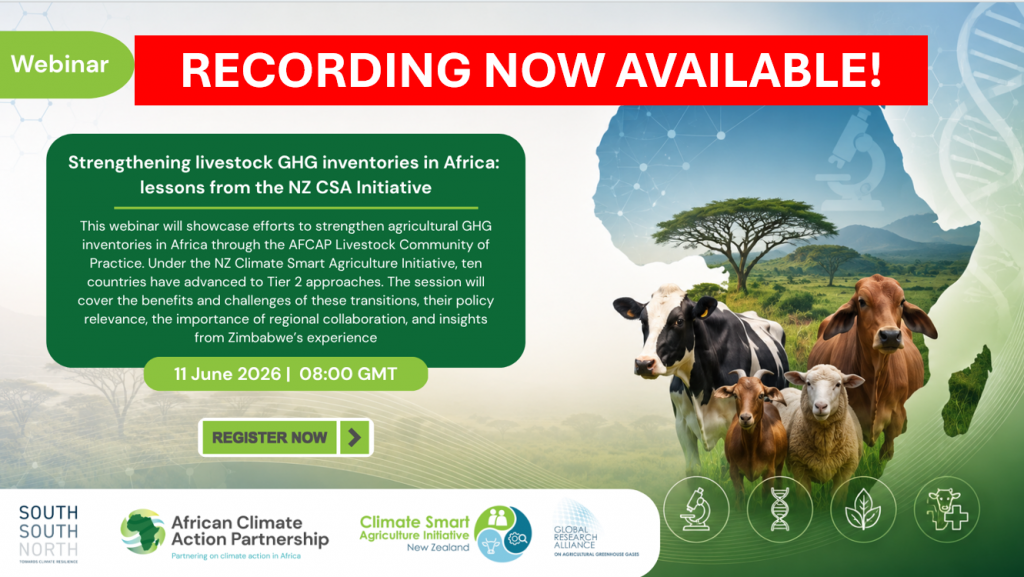
The Global Research Alliance (GRA), the African Climate Action Partnership (AfCAP), and the Government of New Zealand co-hosted this webinar to showcase the achievements of the New Zealand Climate Smart Agriculture (NZCSA) Initiative. The session highlights the initiatives key capability-building efforts across Africa focused on improving agricultural greenhouse gas (GHG) inventories, and the important role of the AfCAP Livestock Community of Practice. Through the NZCSA Initiative, technical work in ten countries has progressed beyond default emissions estimates to more advanced Tier 2 methodologies, enabling more accurate and country-specific data.
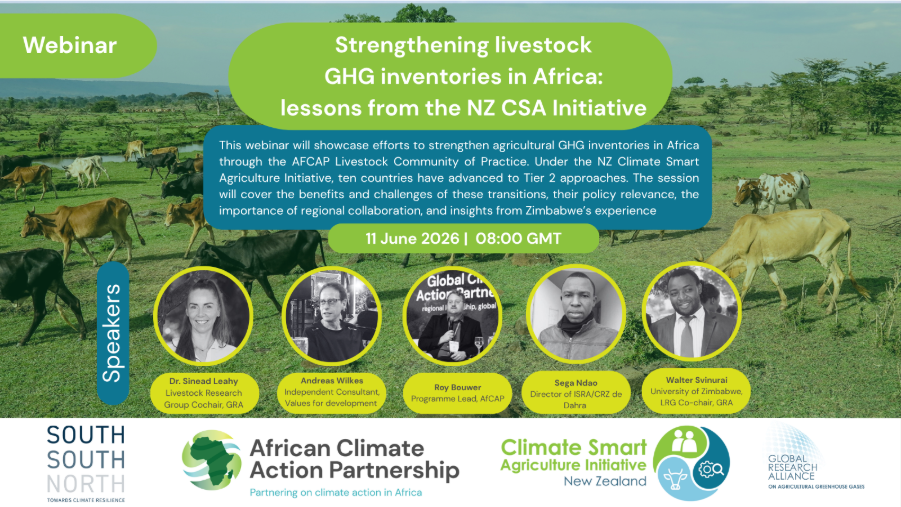
The Speakers
Moderator: Sinead Leahy (Livestock Research Group Co-Chair, GRA) Opening remarks and Context setting
Speaker 1: Andreas Wilkes (Independent consultant, Values for Development Ltd) NZCSA inventory improvement approach and impact across 10 countries
Speaker 2: Walter Svinurai (University of Zimbabwe) Zimbabwe’s progress, policy relevance and regional connections
Speaker 3: Séga Ndao (Director of ISRA/CRZ Dahra – AfCAP/Livestock CoP) Regional Inventory improvement and bilateral exchanges in West Africa
Speaker 4: Roy Bouwer (Programme Lead, South South North) Regional collaboration in Southern and Eastern Africa and the AfCAP Livestock CoP
A video recording of the webinar are now available to view HERE
We’re proud to share the session recordings from the 2026 New Zealand Agriculture and Climate Change Conference!
The recordings cover a wide range of topics, from the latest research and innovation to practical conversations about the opportunities and challenges ahead for reducing agricultural emissions in Aotearoa New Zealand.
The Global Research Alliance (GRA) & the African Climate Action Partnership (AfCAP) cordially invite you to register for our upcoming webinar on “Strengthening livestock GHG inventories in Africa: Lessons from the NZ CSA Initiative”. This engaging session will bring together inventory and livestock experts, national inventory compilers, researchers, government officials, and development partners involved in agricultural GHG measurement and reporting to gain practical insights into how African countries are strengthening agricultural GHG inventories through Tier 2 approaches. Attendees will also learn about the benefits and challenges of these transitions, their policy relevance, the value of regional collaboration, and hear directly from Zimbabwe’s experience.
Webinar Overview:
This session will showcase key capability-building activities in Africa, centred on improving agricultural GHG inventories, and the role of the AFCAP Livestock Community of Practice. Under the NZ Climate Smart Agriculture (CSA) Initiative, technical work in ten countries has moved beyond default emissions estimates to full Tier 2 approaches. The webinar will highlight the practical benefits and challenges of Tier upgrades, their policy relevance, the value of regional collaboration through AFCAP, and insights from the Zimbabwean government.
Event Details
Title: Strengthening livestock GHG inventories in Africa: Lessons from the NZ CSA Initiative
The Global AgriInno Challenge (GAC) 2026 is now accepting applications from innovators worldwide working to transform agrifood systems in Small Island Developing States.
Jointly organized by the Food and Agriculture Organization of the United Nations (FAO), Zhejiang University, and Pinduoduo, this sixth edition of the competition places SIDS at the center of global agrifood innovation, regions that face some of the world’s most pressing climate and food security challenges yet remain underserved by mainstream technology ecosystems.
GAC 2026 is open to agripreneurs and startups from any country, provided their solution directly addresses agrifood challenges facing SIDS or has been deployed within a SIDS context. Teams originating from or led by individuals from SIDS are strongly encouraged to apply.
Thirteen finalists will be selected through a competitive global screening process. Five of these spots are reserved for teams from the twelve SIDS countries participating in the FAO-China South-South Cooperation Project: Bahamas, Barbados, Cabo Verde, Comoros, Cook Islands, Fiji, Grenada, Maldives, São Tomé and Príncipe, Solomon Islands, Trinidad and Tobago, and Vanuatu.
All finalists will travel to Hangzhou, China in August 2026 for an immersive week of expert workshops, investor matchmaking, and the Global Final Pitch before an international jury.
Join this upcoming event within the Community of Practice, which is jointly organized by the “4 per 1000” Initiative and GIZ Sector Project Soil Protection, Combating Desertification, Sustainable Land Management (SV Boden). Panel discussion on: Soil carbon sequestration and food security in Sub-Saharan Africa (SSA): Synergies and Tradeoffs What to expect:Carbon sequestration in nutrient-deprived agricultural soils in sub-Saharan Africa (SSA) seems to hold a great potential to tackle two of the most pressing issues of our time: food insecurity and…
In 2022, the Climate and Clean Air Coalition (CCAC) is celebrating its 10th year of supporting national action to rapidly slow global temperature rise and reduce air pollution. Over the past ten years the CCAC has supported 37 countries to develop national action plans and policies and translate these into action. Two webinar sessions will be held on Tuesday, 29 March to highlight four countries - Colombia, Maldives, Nigeria and Pakistan - that have successfully integrated climate and air quality…
In 2022, the Climate and Clean Air Coalition (CCAC) is celebrating its 10th year of supporting national action to rapidly slow global temperature rise and reduce air pollution. Over the past ten years the CCAC has supported 37 countries to develop national action plans and policies and translate these into action. Two webinar sessions will be held on Tuesday, 29 March to highlight four countries – Colombia, Maldives, Nigeria and Pakistan – that have successfully integrated climate and air quality…
A transition towards a circular bio-based and climate smart society is the answer to many of the societal challenges we are facing today. Circular systems in the green and in the blue domain will close water, nutrient and carbon cycles and from this, minimize resource losses and climate change effects, and hence assure that society can live within the planetary boundaries. Based on the call for sessions, the organizing committee has developed an inspiring program that supports the identification of…
Join CIGAR for this round table on 'Policy coherence for climate-smart agriculture in Africa'. Accelerating Impacts of CGIAR Climate Research for Africa (AICCRA) has led extensive analysis and dialogues on the coherence of policies that support - or sometimes even undermine - our ambitions for more climate-smart agriculture across Africa. Our research has identified the issues. And through our engagement, we're developing recommendations that address critical gaps in the design, implementation, monitoring and financing of climate action and the transformation…
The Joint Programming Initiative for Agriculture, Food Security and Climate Change (FACCE-JPI) is pleased to invite you to a workshop on 25 April 2022, entitled “Science Advice to Policy Coherence for Sustainable Food Systems”. This workshop aims to bring together policy makers, academics and representatives of stakeholder organisations to discuss effective science to policy advice for food systems policy coherence. The discussions will centre around the holistic and integrated approaches that include trade-offs and synergies, which is the focus of…
Leaders of the BovINE Environmental Sustainability Thematic Working Group, Riet Desmet and Karen Goosens will be joined by experts Paul Pardon, Josselin Andurand and Ennio Facq for this webinar focusing on Carbon Sequestration. Carbon sequestration is an important part of the reduction of greenhouse gases. In this, beef production systems can play an important role and help to improve soil health. Different ways exist to sequester more carbon (C) in the soil. A known practice, yet newly discovered in some…
The international conference on 'Zero Greenhouse Emission in High Productive Agriculture - ZEA' will be held 3 - 5 May 2022 in Copenhagen, Denmark. The conference is organised by Aarhus University and hosted and financially supported by Novo Nordisk Foundation and the venue is Tuborg Havnevej 19, DK-2600 Hellerup. Greenhouse gas emissions from agriculture originate from livestock, manure, soils, land use and fossil fuels. Society is increasingly successful in reducing emissions from non-agricultural sectors, and within a few years, agriculture will…
May 10, 2022 @ 1:00 pm - May 12, 2022 @ 3:00 pm CEST
European seminar on research and innovation in sustainable crop production & workshop on enhancement and optimization of innovation SusCrop is an ERA-Net Cofund Action under H2020, which aims to strengthen the European Research Area (ERA) in the field of Sustainable Crop Production. In 2019 under the first co-funded Call, SusCrop selected 13 transnational research projects for funding within the area of sustainable and resilient crop production. For more details about the 1st call and selected projects, please visit this website. In…
CCAC Partners and all interested parties are invited to join the CCAC Agriculture Hub's first Full Hub meeting on 12 May 2022. It will be co-chaired by representatives from Costa Rica, the US, and Vietnam. The meeting will focus on the livestock sector and will be held in 3 parts: Part 1 will include presentations on country best practices and science and research; Part 2 will bring together a panel to focus on barriers to implementation; and Part 3 will…
This webinar series is sponsored by the International Soil Carbon Network in partnership with the Midwest, Northeast, and Northwest USDA Climate Hubs, the American Geophysical Union, and the tri-societies–the American Society of Agronomy, Crop Science Society of America, and Soil Science Society of America. Keen public interest in soil carbon sequestration will test the scientific community’s ability to deliver effective soil management practices and durable scientific concepts. In this webinar series we will hear diverse perspectives on key questions that…
New Joint Research Mechanism on climate and agriculture launched between Ireland and New Zealand The Joint Research Initiative enables research calls to address the impact of high to medium-intensity grassland livestock systems on the climate and the environment. It builds on established research links between Ireland and New Zealand and strengthens existing cooperation and collaboration between funders and researchers on a bi-lateral basis. The first research call under this initiative has been launched – "Strategies, technologies and novel production systems…