7104

Latest News

June 2, 2026   •   News

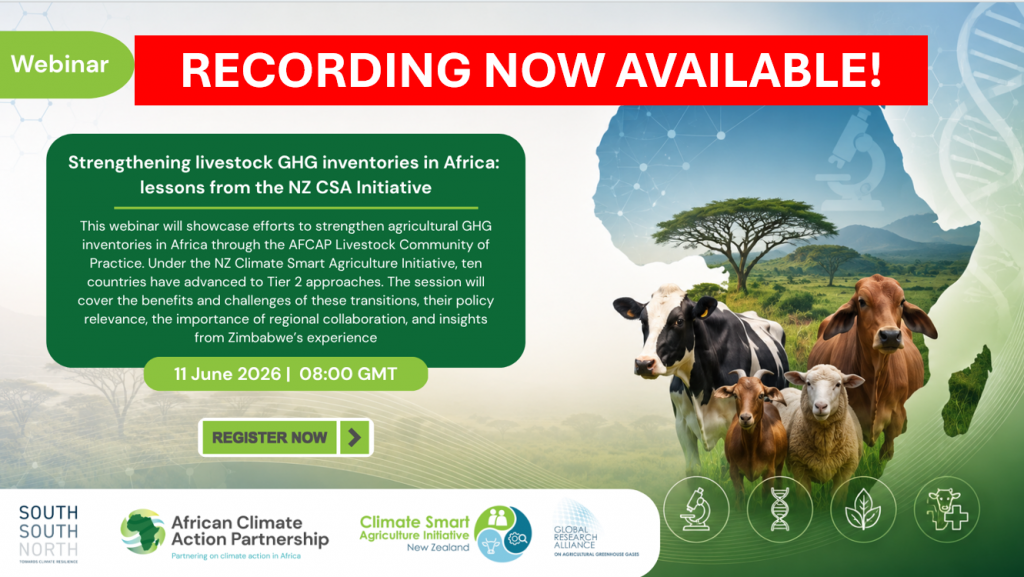
The Global Research Alliance (GRA) & the African Climate Action Partnership (AfCAP) cordially invite you to register for our upcoming webinar on “Strengthening livestock GHG inventories in Africa: Lessons from the NZ CSA Initiative”. This engaging session will bring together inventory and livestock experts, national inventory compilers, researchers, government officials, and development partners involved in agricultural GHG measurement and reporting to gain practical insights into how African countries are strengthening agricultural GHG inventories through Tier 2 approaches. Attendees will also learn about the benefits and challenges of these transitions, their policy relevance, the value of regional collaboration, and hear directly from Zimbabwe’s experience. 

Webinar Overview:   

This session will showcase key capability-building activities in Africa, centred on improving agricultural GHG inventories, and the role of the AFCAP Livestock Community of Practice. Under the NZ Climate Smart Agriculture (CSA) Initiative, technical work in ten countries has moved beyond default emissions estimates to full Tier 2 approaches. The webinar will highlight the practical benefits and challenges of Tier upgrades, their policy relevance, the value of regional collaboration through AFCAP, and insights from the Zimbabwean government.   

Event Details   

Title: Strengthening livestock GHG inventories in Africa: Lessons from the NZ CSA Initiative 

When: 11 June 2026 

Time: 10:00 SAST / 11:00 EAT / 09:00 WAT / 08:00 GMT 

Where: Via Zoom  

REGISTER HERE  

May 29, 2026   •   News

The Global AgriInno Challenge (GAC) 2026 is now accepting applications from innovators worldwide working to transform agrifood systems in Small Island Developing States.

Jointly organized by the Food and Agriculture Organization of the United Nations (FAO), Zhejiang University, and Pinduoduo, this sixth edition of the competition places SIDS at the center of global agrifood innovation, regions that face some of the world’s most pressing climate and food security challenges yet remain underserved by mainstream technology ecosystems.

GAC 2026 is open to agripreneurs and startups from any country, provided their solution directly addresses agrifood challenges facing SIDS or has been deployed within a SIDS context. Teams originating from or led by individuals from SIDS are strongly encouraged to apply.

Thirteen finalists will be selected through a competitive global screening process. Five of these spots are reserved for teams from the twelve SIDS countries participating in the FAO-China South-South Cooperation Project: Bahamas, Barbados, Cabo Verde, Comoros, Cook Islands, Fiji, Grenada, Maldives, São Tomé and Príncipe, Solomon Islands, Trinidad and Tobago, and Vanuatu.

All finalists will travel to Hangzhou, China in August 2026 for an immersive week of expert workshops, investor matchmaking, and the Global Final Pitch before an international jury.

Click HERE for further information.

May 29, 2026   •   News

The GANASUR team during a recent Workshop

The GANASUR project – “Developing Mitigation Strategies for the Livestock Sector Through a Collaborative Approach Across the Southern Cone”– is wrapping up in June, but it has positioned the region as a leader in low-emissions livestock approaches in South America.

Funded through the New Zealand Government’s Climate Smart Agriculture Initiative, as part of its contribution to the Global Research Alliance on Agricultural Greenhouse Gases (GRA), and coordinated by PROCISUR, GANASUR brought together leading scientific institutions from Argentina, Brazil, Chile, Paraguay, and Uruguay. This regional collaboration has generated practical evidence that can be used directly by policymakers.

From Fragmented Data to a Shared Evidence Base

A core achievement of GANASUR is the development of harmonised, region-wide “Business-As-Usual” baselines across diverse beef production systems in the Southern Cone. By using consistent methods and verifying typical pastural beef systems, the project created a shared evidence base to enable:

  • robust comparison of mitigation strategies across countries,
  • greater confidence in regional and national emissions estimates, and
  • consistency with international reporting and GRA priorities.

This shared baseline is a critical step toward mitigation actions that can be compared and scaled up. It also allowed the creation of mitigation scenarios, which are useful because they show both the full potential and the realistic pathway for action:

  • Maximum Theoretical Scenario – representing the highest potential mitigation achievable under full implementation of all measures. This helps set ambition and understand the total opportunity.
  • Plausible Scenario – reviewed and agreed by stakeholders within each participating country. This makes it far more relevant for policy design and implementation.

Identifying What Works: Mitigation with Measurable Impact

GANASUR has moved beyond theory to quantify what mitigation options actually deliver across productivity, emissions, and profitability. The project is assessing practical interventions, including:

  • improved reproductive efficiency,
  • optimised grazing and forage systems, with a particular focus on enhancing forage quality (digestibility and nitrogen content) and availability,
  • strategic supplementation, and
  • enhanced animal health management.

Anti-methanogenic feed or additives impacts are evaluated on methane (CH₄) and nitrous oxide (N₂O) emissions up to the farm-gate to ensure that mitigation pathways are grounded in real farm performance.

Linking Science and Policy: The Economics of Mitigation

A key innovation is the development of Marginal Abatement Cost Curves (MACCs) tailored to Southern Cone systems. For each mitigation practice in livestock systems (e.g. better grazing, improved reproduction, feed additives), a MACC answers two key questions:

  1. How much can this reduce emissions? (the abatement potential)
  2. What does it cost to achieve that reduction? (the cost per unit of emissions reduced)

These options are then plotted so you can compare them side by side. These provide policymakers with clear insights into the:

  • cost-effectiveness of mitigation options,
  • trade-offs between emissions reduction and farm profitability, and
  • opportunities for low-cost, high-impact interventions.

This economic lens is essential for designing credible, implementable mitigation policies and investment strategies.

Why GANASUR Matters for the scientific Community

GANASUR delivers exactly what is needed to accelerate progress aligned with the goals of the GRA:

  • Comparable, regionally harmonised data frameworks
  • Evidence on scalable mitigation practices
  • Integration of productivity, resilience, and emissions outcomes
  • Direct relevance for policy and investment decisions

As countries seek to balance food production, economic growth, and emissions reduction, GANASUR provides a replicable model for evidence-based, regionally coordinated climate action in livestock systems.

Its insights will inform policy development, mitigation strategies, and international collaboration, helping ensure that livestock systems in the Southern Cone and beyond are productive, resilient, and aligned with global climate ambitions.

Read more HERE:

Loading Events

Past Featured Events

November 2024

Registration for the Nagoya Protocol Workshop is now open!

November 21, 2024 @ 1:00 pm - 3:00 pm UTC+1

We invite you to an information session about the implications of the Nagoya Protocol for researchers working with biological material from abroad. Institutions from around the word recognize the importance of compliance with this international framework and supports its implementation. In this information event, the German Nagoya Protocol HuB project will share its expertise with you and give you relevant insights and necessary information to assess whether your research might also have ABS obligations to take into consideration. During this information event,…

Find out more »

The Climate and Clean Air Coalition (CCAC) needs your help – Choose your date and time

November 21, 2024 @ 10:00 pm - 11:00 pm NZDT
|Recurring Event (See all)

One event on November 22, 2024 at 4:00 pm

One event on November 23, 2024 at 8:00 am

One event on November 25, 2024 at 9:00 pm

One event on November 26, 2024 at 6:00 am

The Climate and Clean Air Coalition, a Partner in the Global Research Alliance (GRA), is producing a comprehensive integrated assessment on greenhouse gas emissions and short-lived climate pollutants (SCLP) from the Agricultural and Food sector. The report, to be presented at COP 30 in Brazil, will develop national scale SLCP and GHG emission scenarios for 2050. These will explore ‘emission pathways’ comprising combinations of policies and mitigation measures designed to reduce emissions through e.g. changes in national diets, livestock and…

Find out more »

December 2024

New Zealand Agriculture & Climate Change Conference 2024

December 3, 2024 @ 8:30 am - December 4, 2024 @ 4:45 pm NZDT

Virtual registrations for the New Zealand Agriculture and Climate Change Conference are open! Join us online for the New Zealand Agriculture and Climate Change Conference, 3rd - 4th December 2024! This key event will bring together industry leaders, experts, and  researchers to share insights on the most pressing issues at the intersection of agriculture and climate change. Virtual registrations are still open, so don’t miss your chance to be part of this vital conversation. Register now to secure your spot!…

Find out more »

WTO Annual Agriculture Symposium 2024: Trade and Nutrition – Exploring the Nexus

December 9, 2024 @ 10:00 am - 7:00 pm UTC+1

Please note that there is no registration required for this event.  You can follow the Symposium live on the WTO YouTube Channel by clicking on the electronic links in the attached program. This is an interactive event and we encourage you to send your questions to the various panels at [email protected]

Find out more »

NZAGRC State of Science Webinar Series

December 10, 2024 @ 10:00 am - 11:00 am NZDT

Join us as Louis Schipper and Owen Fenton discuss the challenges of managing soil carbon on agricultural peatlands. A surprisingly high share of New Zealand's carbon dioxide emissions comes from a tiny proportion of soil - peat bogs that have been drained to support productive agriculture. Estimates indicate that drained peatlands in New Zealand (<1% of the land area) contribute about 8% of our national net greenhouse gas emissions. A similar emissions profile is estimated for Ireland. Is there anything…

Find out more »

January 2025

Launch event: Sustainable nitrogen management in agrifood systems

January 20, 2025 @ 12:30 pm - 2:00 pm CET

Launch of the FAO Report "Sustainable Nitrogen Management in Agrifood Systems" Explore key findings, solutions for efficiency, & the updated #FAOSTAT nitrogen database. Register Here

Find out more »

February 2025

WEBINAR: Agroecology, agroforestry, bioeconomy and policy: balancing climate change

February 13, 2025 @ 8:00 pm - 9:30 pm UTC+1

Exploring the connections between agroecology, agroforestry & climate change Join our upcoming webinar with Professor María Rosa Mosquera-Losada from the University of Santiago de Compostela. She'll discuss the global extent of agroecology and agroforestry, and their links to sustainable farming systems, bioeconomy, and climate change. Professor Mosquera-Losada brings extensive expertise in agroforestry, agroecology, and ecosystem services, with a strong track record of EU project coordination and research collaborations. 🗓️13 Feb 2025 ⏰20:00 CET 🖊️Register HERE

Find out more »

Rice Technical Working Group 2025 Conference

February 17, 2025 @ 8:00 am - February 20, 2025 @ 5:00 pm UTC-5

The Rice Technical Working Group (RTWG) meets at least biennially to provide for continuous exchange of information, cooperative planning, and periodic review of all phases of rice research and extension being carried out by the states, federal government, and cooperating agencies. It develops proposals for future work, which are suggested to the participating agencies for implementation. The RTWG 2025 conference will be held at the Hilton New Orleans Riverside in New Orleans, Louisiana. Dates for the conference are February 17-20,…

Find out more »

WTO Webinar – AgTech & Global Trade: Bridging The Future of Agriculture

February 18, 2025 @ 2:00 pm - 3:30 pm UTC+1

Please note that there is no registration required for this event.  You can follow the event live on the WTO YouTube Channel and visit our Webpage WTO | Trade Dialogues on Food. Please click for our Catalogue of Trade Dialogues on Food and Big Take-Aways Volume I and Volume II. Remember: You can send your questions to [email protected] either before or during the dialogue.  We count on your active participation!

Find out more »

OECD webinar: Farm-level tools in practice: ECOGAN in Spain

February 18, 2025 @ 4:00 pm - 5:00 pm UTC+1

The OECD is holding a webinar on the Spanish ECOGAN tool for farm-level GHG calculations on Tuesday 18 February, from 4pm-5pm Paris time. In 2023-2024, OECD work explored the building blocks needed for measuring carbon footprints of agri-food products. On 24 February, they will publish their report Measuring Carbon Footprints of Agri-Food Products, which discusses the eight building blocks in detail. A crucial building block is the availability of reliable and easy-to-use farm-level calculation tools. The Spanish Ministry for Agriculture, Fisheries and Food…

Find out more »

Webinar on Soil Carbon in Africa

February 20, 2025 @ 11:00 am - 12:30 pm UTC+1

If you'd like to learn more about soil health and soil carbon solutions in Africa, join us tomorrow morning, for a webinar organised by the Forum for Agricultural Research in Africa (FARA), the Soil Carbon IRC's representative for the African continent  You'll have the opportunity to learn more about current soil projects and policies, including the 10-Year Fertiliser and Soil Health Action Plan. You'll also receive information about future opportunities and collaboration, as well as the role of the Soil Carbon IRC and its…

Find out more »

Advanced course – Cattle Breeding for Low Methane Emissions: From Farm Measurement to Genetic Progress

February 24, 2025 @ 8:00 am - February 28, 2025 @ 5:00 pm UTC+2

Key reasons to attend this course AdmissionThe course is designed for professionals with a university degree, and oriented towards researchers, academic and decision-makers from public and private institutions, PhD students and technical advisors involved in the development and implementation of cattle breeding and genetic programmes. - 30 places will be available for face-to-face participation with access to lectures, practical sessions, case studies and technical trips (30 hours). - 10 places will be available for online participation with access to lectures,…

Find out more »
+ Export Events