
To receive our latest news, event details and publications directly.
Scaling Next Generation Rice Impact Program Webinar Series

Scaling Next Generation Rice Impact Program Webinar Series
February 25 @ 6:00 am – 8:00 am EST
Accelerating Robust and Scalable Measurement, Reporting and Verification
Wednesday, February 25, 2026
Time: 6:00 - 8:00 am Washington, DC | 12:00 pm Paris | 4:30 pm Mumbai | 5:00 pm Dhaka | 6:00 pm Jakarta, Phnom Penh, Hanoi | 7:00 pm Beijing, Manila
Background:
The World Bank Group is hosting a webinar series, Measurement Matters: Sustainable Pathways for Next Generation Rice, to engage country participants and partners in the Scaling Next Generation Rice Impact Program. The series is open to all members of the Scaling Next Generation Rice Community of Practice and beyond. Responding to participant demand, the series focuses on how measuring climate outcomes from sustainable rice production can be monetized through market-based mechanisms. The series explores how robust, science-based measurement, reporting, and verification (MRV) frameworks enable stakeholders to quantify emissions reductions from climate smart rice practices and use this data to access compliance and voluntary carbon markets. Through examples from country pilots, carbon standards, digital MRV tools, and carbon market actors, the series highlights how scaling MRV capacity can support national climate goals, attract private climate finance, and unlock new revenue streams for farmers across Asia.
Description:
This first webinar—Accelerating Robust and Scalable Measurement, Reporting and Verification—will focus on country, jurisdictional, and project readiness to engage with carbon markets and other incentive mechanisms for low emissions rice. It will introduce rigorous agricultural greenhouse gas (GHG) accounting practices as the foundation of scalable MRV systems that meet technical standards for transparency and environmental integrity. Drawing on international and regional research networks and pilot MRV initiatives in South and Southeast Asia, the session will combine expert insights with interactive peer exchange to support learning and collaboration
Objectives:
- Understand the core technical building blocks of robust, scalable MRV systems for rice-related emissions.
- Explore how repeated, high-quality measurement at scale can unlock climate finance opportunities for low emissions rice.
- Combine global and regional expert insights with peer exchange among country participants to explore what’s working internationally—and how to apply those lessons in country contexts.
Speaker Bios
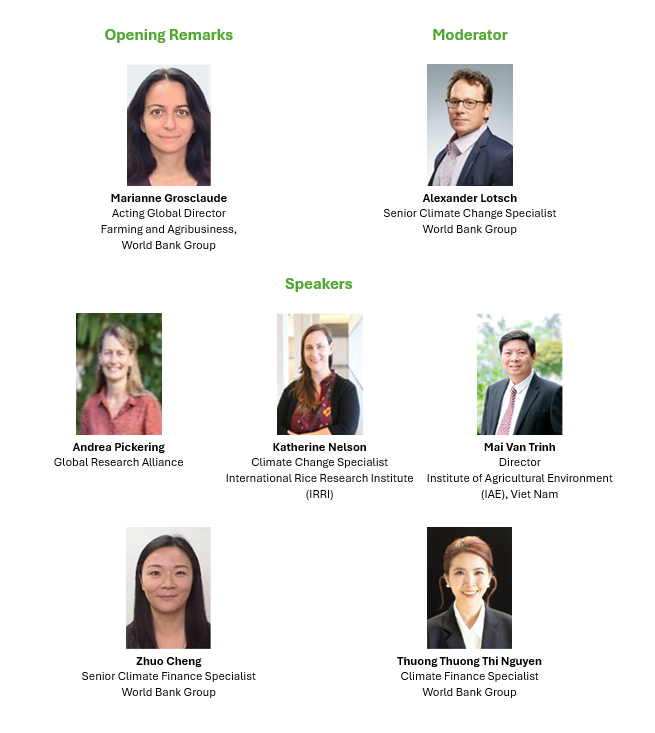
Marianne Grosclaude is currently the Acting Director of the World Bank Group Department of Farming and Agribusiness. She is the Manager for Farming and Agribusiness, Policy & Regulations. She has worked for the World Bank for the past 25 years in technical and managerial roles, across several regions including the Middle East and North Africa, West and Central Africa, Europe and Central Asia, Latin America and the Caribbean and East Asia and the Pacific. Her work has focused on agricultural and food policies, agricultural trade policies and regional integration, inclusive agricultural value-chain development, and the nexus between agriculture, environment, and climate change. Ms. Grosclaude is an agricultural economist by background. She speaks French, English, Portuguese and Spanish.
Alexander Lotsch is a Senior Climate Finance Specialist with the World Bank’s Global Department for Farming and Agribusiness, where he shapes strategic engagement on climate finance, climate analytics, and food system transformation. He is co-author of the World Bank flagship report, Recipe for a Livable Planet: Achieving Net Zero Emissions in the Agrifood System. Previously, he led work on nature-based solutions, forests, and land use as well as the economics of adaptation, climate risk management, agricultural weather insurance, and decision-making under climate uncertainty. Prior to joining the World Bank in 2004, he worked at the National Aeronautics and Space Administration and the Environmental Systems Research Institute. He holds a PhD in earth system science and an MA in geography from Boston University, and undergraduate degrees in physical geography from Free University Berlin and in agricultural sciences from Humboldt University Berlin.
Andrea Pickering, Global Research Alliance. She is the Programme Lead for New Zealand’s Agricultural MRV capability building programme. She holds a PhD in Plant Physiology, with a research background in soil science and climate impacts on plant production. She was the lead compiler of the New Zealand Agricultural Inventory from 2009 and played a key role in developing QA/QC processes and Tier 3 inventory methodology. Andrea has contributed to the development of the NZ Emissions Trading Scheme and international research initiatives under the Global Research Alliance. Through New Zealand’s support to the GRA, she has led agricultural MRV capacity building in developing countries and currently cochairs the GRA Inventory and NDC Network. She is also a UNFCCC expert reviewer.
Katherine (Katie) Nelson is a Climate Change Scientist with over 15 years of experience in agriculture and international development. She holds a Ph.D. in Behavioral Economics and specializes in carbon markets, climate finance, mitigation technologies, MRV systems, emissions calculation, and digital tool development. Katie has led global development portfolios and conducted applied research on methane mitigation and environmental behavior change in agriculture. She focuses on translating scientific research into practical, actionable solutions that inform policy and drive sustainable impact.
Assoc. Prof. Dr. Mai Van Trinh is Director General of the Institute for Agricultural Environment (IAE) under the Viet Nam Academy of Agricultural Sciences. With over 35 years of experience, he is a leading expert in agricultural extension, soil conservation, environmental modelling, and climate change. His work focuses on crop modelling, greenhouse gas inventories, climate mitigation and adaptation, and support to Viet Nam’s agricultural climate policies, including NDC development, net zero agriculture planning, low emission rice systems, and circular agriculture. He also teaches environmental modelling and climate change at universities and research institutions in Viet Nam.
Zhuo Cheng is a Senior Climate Finance Specialist in the Climate Finance Solutions Unit of the World Bank Group’s Global Climate Department. She has worked in several World Bank Group offices, including Washington, DC, China, Sri Lanka, and Viet Nam, and is currently based in Singapore. Zhuo holds a Master’s degree in International Public Policy from University College London (UK), an LL.M. from the University of Sheffield (UK), and a Bachelor of Laws from Zhongnan University of Economics and Law (China). She has over 18 years of experience in climate and carbon finance policies and operations across multiple regions, covering the energy, transport, agriculture, urban, and environment sectors.
Thuong Nguyen is a Climate Finance Specialist in the Carbon Finance Solutions Unit of the World Bank Group’s Global Climate Department, based in Washington, D.C. Her work focuses on mobilizing carbon finance for rice and livestock projects across countries including India, Viet Nam, and Bangladesh. This includes developing MRV systems, supporting countries in carrying out carbon transactions, and assessing how green finance tools can unlock investment along agricultural value chains. Prior to joining the World Bank, Thuong worked at the UNFCCC’s Mitigation Department supporting Article 6 carbon market implementation under the Paris Agreement, and previously with GIZ and GGGI in Viet Nam. She holds a Master’s degree in Development Policy from Germany and a Bachelor’s degree in Economics from Viet Nam.
ZOOM CONNECTION DETAILS :
https://worldbankgroup.zoom.us/j/94793221536?pwd=GQXXinZFqIm21awUDVm6EVnemG32Sy.1
Meeting ID: 947 9322 1536
Passcode: $mYng2$uYs