
To receive our latest news, event details and publications directly.
WEBINAR : MANURE MANAGEMENT NETWORK Methods to calculate methane emission from stored liquid manure

WEBINAR : MANURE MANAGEMENT NETWORK Methods to calculate methane emission from stored liquid manure
April 15 @ 3:00 pm – 4:00 pm CEST
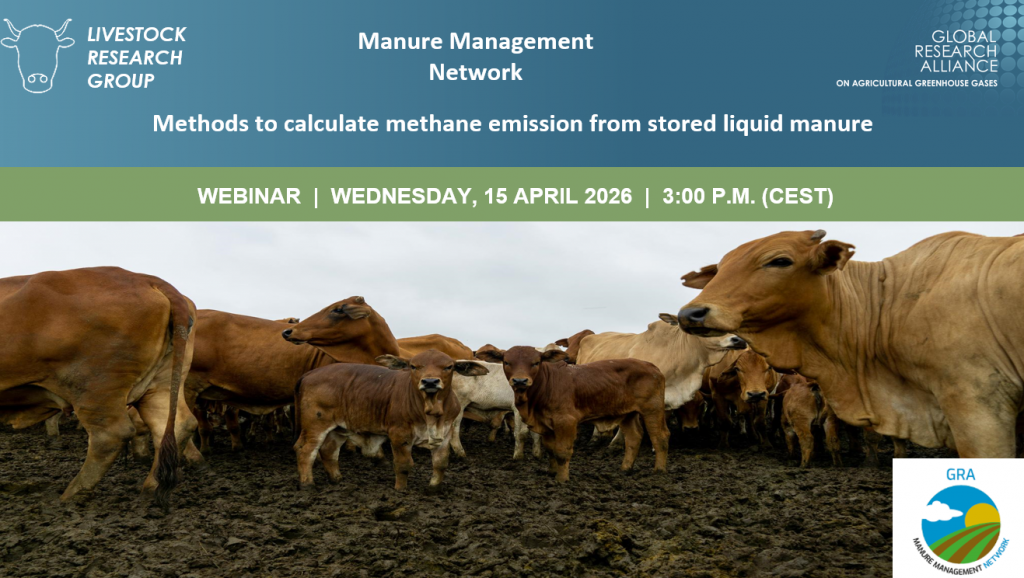
Manure management on livestock farms contributes significantly to the climate impact of agriculture via emissions of methane, nitrous oxide and ammonia. The IPCC tier 2 method to estimate methane emissions, developed in 1996, is based on the maximal methane production rate of fresh excreta (B0) and a conversion factor MCF to account for storage conditions. This calculation concept was meant to be simple, because it should be applicable worldwide, including regions where the staff carrying out the calculations has limited information about manure management systems or expertise in how management and environmental conditions may affect the processes behind methane emissions. Three researchers with much experience in developing models to calculate methane emissions from livestock farming will present new improvements of the tier 2 method as well as alternative approaches for calculating the emission. The intention of the webinar is to stimulate new initiatives to investigate the calculation of methane emissions from manure management, with the aim to develop a new generation of methods.
Biographies
Andrew C. VanderZaag, Science and Technology Branch, Agriculture and Agri-Food Canada, Ottawa, ON, Canada.
Dr. Andrew VanderZaag is a Research Scientist with Agriculture and Agri-Food Canada at the Central Experimental Farm in Ontario, Canada. He was a Contributing Author of the 2019 IPCC Refinement to the guidelines for National Greenhous Gas Inventories. His research focuses on greenhouse gas emissions measurement and mitigation from dairy and swine manure systems and involves farm sites across Canada. This research leads to new approaches in beneficial management practices that producers can use to reduce emissions and improve their carbon footprint.
Søren O, Petersen. Department of Agroecology, Aarhus University
Søren O. Petersen has a background in microbial ecology. His research focuses on the interactions between soil, organic amendments and microbial communities, with an emphasis on carbon and nitrogen cycling and the mitigation of greenhouse gas emissions in agricultural systems. He has contributed to fundamental and applied studies on gaseous emissions (such as nitrous oxide and methane), manure management, and environmental controls affecting soil microorganisms.
Frederik Rask Dalby, Aarhus University, Faculty of Technical Sciences (Tech), Department of Biological and Chemical Engineering
Frederi R. Dalby has specialized in process modelling of organic matter transformation and methane emission from manure management systems. Recently, much of his research has been focused on developing a tool for estimating farm-scale GHG emission, including prediction of effects of mitigation technologies. Frederik is therefore involved in documentation and testing of mitigation technologies both in-situ and in the laboratory.
Sven G. Sommer (Aarhus University, Faculty of Technical Sciences (Tech). Department of Biological and Chemical Engineering, Denmark,
Sven G. Sommer is a specialist in bio-waste engineering with focus on emission of ammonia (NH3), the greenhouse gases methane (CH4) and nitrous oxide (N2O), separation of animal manure and organic biowaste and biogas production. His research has a strong focus on bio-waste chemistry and biological and chemical processes affecting transformation of organic matter in biowaste. He has been involved in Public Sector Consultancy for most of his career giving advice on environmentally friendly management of animal manure and how to enhance this with incentives and regulations.
Click HERE to register.