
Flagship goal: The overarching goal of this flagship is to deepen the understanding of how plants with biological nitrification inhibition (BNI) capacity can be used to reduce N2O emissions from agricultural soils. The project will connect existing BNI research projects and researchers to compare BNI from different plant species, environmental and management conditions. The project will also come up with guidelines on best practice methodologies to evaluate BNI and provide capacity building on the topic. Finally, the project will identify research gaps and facilitate international collaborative projects.
Global agriculture contributes with approximately half of the anthropogenic N2O emissions, and one third of agricultural N2O emissions being derived from livestock manure. Nitrous oxide is produced by denitrifying bacteria, transforming nitrate to N2O. Before N2O is produced, nitrogen in livestock manure and urine first have to go through several transformations. An important step is nitrification, i.e. conversion of ammonium to nitrate. Synthetic nitrification inhibitors have showed to be effective in preventing nitrification in the short term, but high prices and concerns about residues in food products has contributed to the need of finding alternatives.
The last decades, researchers have identified several plant species with the capacity to reduce nitrification rates in soils, referred to as biological nitrification inhibition (BNI). Several secondary metabolites produced by plants have been identified and isolated, which have shown to inhibit nitrification. It has also been shown that soil where these plants have been growing have lower abundance of ammonium oxidising bacteria and archaea and reduced N2O emissions. However, results are not consistent, and a better understanding of when BNI works is needed for the practice to be advised to farmers.
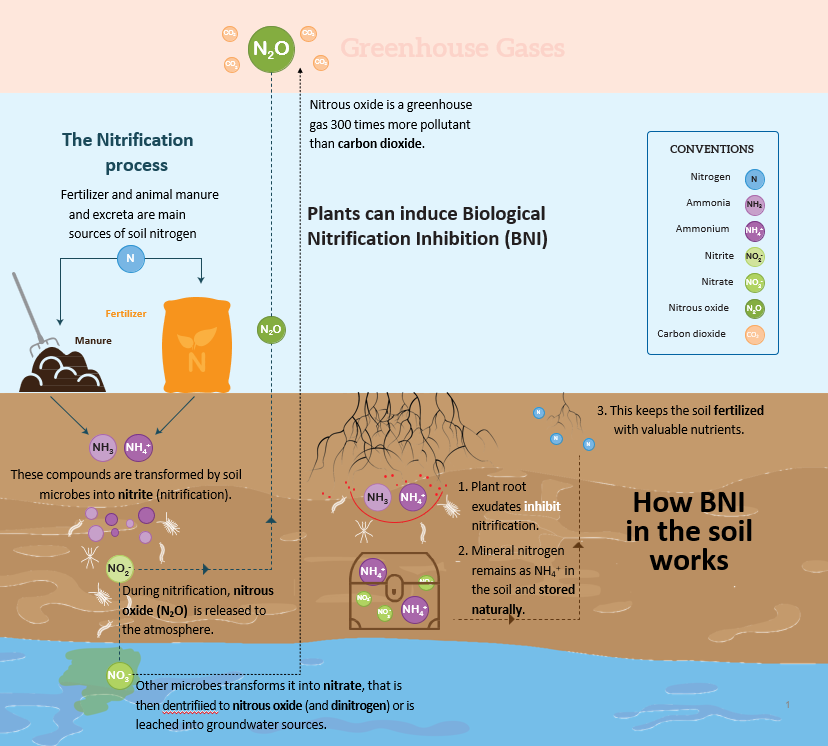
To accelerate the development of BNI as a N2O mitigation strategy for agricultural systems, the project will work on three objectives:
- Connect existing research projects across the world using a genotype x environment x management framework (2026).
- Based on existing methods develop guidelines for common research methodologies, approaches and protocols to allow for better comparison between studies and aid decision making in new projects (2026). A low-cost high-throughput screening methodology will be refined and a training program focusing on methodology will be conducted (2027). Finally, we aim to use the screening method to run screenings across the world (2027-2028).
- Define research gaps and potential pathways of implementation of BNI in grass-based livestock systems.
The project started in late 2025 and will run until 2029. Regular webinars throughout the project will be held to update on progress. Please sign up below to receive latest news and updates.
Anticipated outcomes:
Overview of existing BNI networks and projects (2026).
A discussion forum to exchange ideas, approaches and data (ongoing).
Meta-analysis based on the data base projects (2027).
Training program/workshop on BNI methodologies (2027/2028).
Journal publication(s) on BNI research and methodologies across the world (2028/2029).
Opportunities to get involved
If you want to get involved in the flagship, contact any of the flagship co-leads: Jacobo Arango, Elsa Lagerquist, or Cecile de Klein.
If you have a project/network that you want to be included in the BNI flagship overview, please contact Elsa.
Key partners
Bioeconomy Science Institute – New Zealand, Alliance Biodiversity & CIAT – Colombia, Université Libre de Bruxelles and Gembloux Agro Bio-Tech – Belgium, Rothamsted Research – United Kingdom, Bangor University – United Kingdom, Wageningen University Research – The Netherlands, Universidad Politécnica de Madrid – Spain, Teagasc – Ireland, University College Cork – Ireland, Aberdeen University – United Kingdom, FiBL – Switzerland, International Livestock Research Institute – Kenya
Project status
Active
Recordings of BNI flagship webinars
Subscribe to updates
To receive our latest news, event details and publications directly.