7104

Latest News

June 2, 2026   •   News

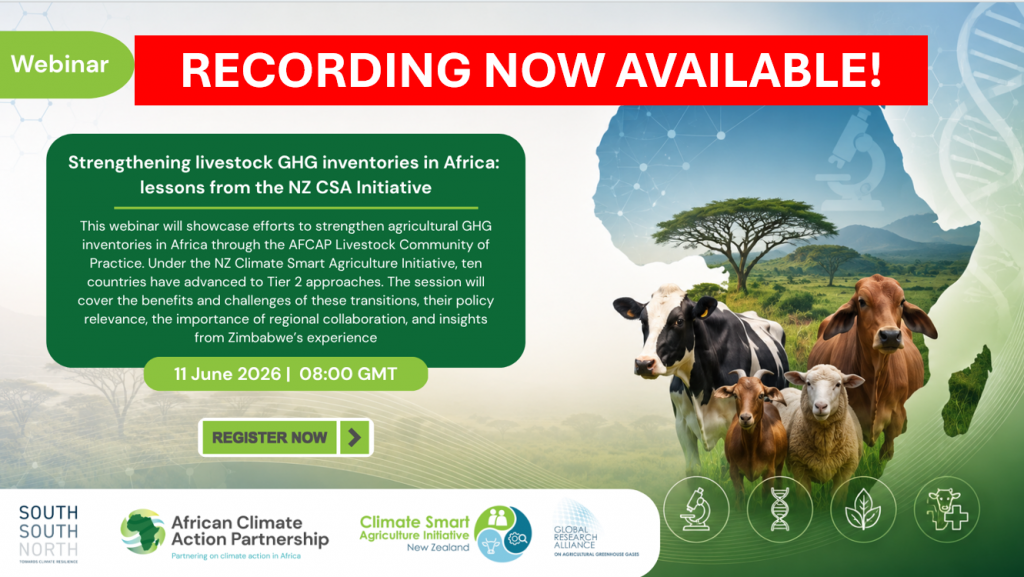
The Global Research Alliance (GRA) & the African Climate Action Partnership (AfCAP) cordially invite you to register for our upcoming webinar on “Strengthening livestock GHG inventories in Africa: Lessons from the NZ CSA Initiative”. This engaging session will bring together inventory and livestock experts, national inventory compilers, researchers, government officials, and development partners involved in agricultural GHG measurement and reporting to gain practical insights into how African countries are strengthening agricultural GHG inventories through Tier 2 approaches. Attendees will also learn about the benefits and challenges of these transitions, their policy relevance, the value of regional collaboration, and hear directly from Zimbabwe’s experience. 

Webinar Overview:   

This session will showcase key capability-building activities in Africa, centred on improving agricultural GHG inventories, and the role of the AFCAP Livestock Community of Practice. Under the NZ Climate Smart Agriculture (CSA) Initiative, technical work in ten countries has moved beyond default emissions estimates to full Tier 2 approaches. The webinar will highlight the practical benefits and challenges of Tier upgrades, their policy relevance, the value of regional collaboration through AFCAP, and insights from the Zimbabwean government.   

Event Details   

Title: Strengthening livestock GHG inventories in Africa: Lessons from the NZ CSA Initiative 

When: 11 June 2026 

Time: 10:00 SAST / 11:00 EAT / 09:00 WAT / 08:00 GMT 

Where: Via Zoom  

REGISTER HERE  

May 29, 2026   •   News

The Global AgriInno Challenge (GAC) 2026 is now accepting applications from innovators worldwide working to transform agrifood systems in Small Island Developing States.

Jointly organized by the Food and Agriculture Organization of the United Nations (FAO), Zhejiang University, and Pinduoduo, this sixth edition of the competition places SIDS at the center of global agrifood innovation, regions that face some of the world’s most pressing climate and food security challenges yet remain underserved by mainstream technology ecosystems.

GAC 2026 is open to agripreneurs and startups from any country, provided their solution directly addresses agrifood challenges facing SIDS or has been deployed within a SIDS context. Teams originating from or led by individuals from SIDS are strongly encouraged to apply.

Thirteen finalists will be selected through a competitive global screening process. Five of these spots are reserved for teams from the twelve SIDS countries participating in the FAO-China South-South Cooperation Project: Bahamas, Barbados, Cabo Verde, Comoros, Cook Islands, Fiji, Grenada, Maldives, São Tomé and Príncipe, Solomon Islands, Trinidad and Tobago, and Vanuatu.

All finalists will travel to Hangzhou, China in August 2026 for an immersive week of expert workshops, investor matchmaking, and the Global Final Pitch before an international jury.

Click HERE for further information.

May 29, 2026   •   News

The GANASUR team during a recent Workshop

The GANASUR project – “Developing Mitigation Strategies for the Livestock Sector Through a Collaborative Approach Across the Southern Cone”– is wrapping up in June, but it has positioned the region as a leader in low-emissions livestock approaches in South America.

Funded through the New Zealand Government’s Climate Smart Agriculture Initiative, as part of its contribution to the Global Research Alliance on Agricultural Greenhouse Gases (GRA), and coordinated by PROCISUR, GANASUR brought together leading scientific institutions from Argentina, Brazil, Chile, Paraguay, and Uruguay. This regional collaboration has generated practical evidence that can be used directly by policymakers.

From Fragmented Data to a Shared Evidence Base

A core achievement of GANASUR is the development of harmonised, region-wide “Business-As-Usual” baselines across diverse beef production systems in the Southern Cone. By using consistent methods and verifying typical pastural beef systems, the project created a shared evidence base to enable:

  • robust comparison of mitigation strategies across countries,
  • greater confidence in regional and national emissions estimates, and
  • consistency with international reporting and GRA priorities.

This shared baseline is a critical step toward mitigation actions that can be compared and scaled up. It also allowed the creation of mitigation scenarios, which are useful because they show both the full potential and the realistic pathway for action:

  • Maximum Theoretical Scenario – representing the highest potential mitigation achievable under full implementation of all measures. This helps set ambition and understand the total opportunity.
  • Plausible Scenario – reviewed and agreed by stakeholders within each participating country. This makes it far more relevant for policy design and implementation.

Identifying What Works: Mitigation with Measurable Impact

GANASUR has moved beyond theory to quantify what mitigation options actually deliver across productivity, emissions, and profitability. The project is assessing practical interventions, including:

  • improved reproductive efficiency,
  • optimised grazing and forage systems, with a particular focus on enhancing forage quality (digestibility and nitrogen content) and availability,
  • strategic supplementation, and
  • enhanced animal health management.

Anti-methanogenic feed or additives impacts are evaluated on methane (CH₄) and nitrous oxide (N₂O) emissions up to the farm-gate to ensure that mitigation pathways are grounded in real farm performance.

Linking Science and Policy: The Economics of Mitigation

A key innovation is the development of Marginal Abatement Cost Curves (MACCs) tailored to Southern Cone systems. For each mitigation practice in livestock systems (e.g. better grazing, improved reproduction, feed additives), a MACC answers two key questions:

  1. How much can this reduce emissions? (the abatement potential)
  2. What does it cost to achieve that reduction? (the cost per unit of emissions reduced)

These options are then plotted so you can compare them side by side. These provide policymakers with clear insights into the:

  • cost-effectiveness of mitigation options,
  • trade-offs between emissions reduction and farm profitability, and
  • opportunities for low-cost, high-impact interventions.

This economic lens is essential for designing credible, implementable mitigation policies and investment strategies.

Why GANASUR Matters for the scientific Community

GANASUR delivers exactly what is needed to accelerate progress aligned with the goals of the GRA:

  • Comparable, regionally harmonised data frameworks
  • Evidence on scalable mitigation practices
  • Integration of productivity, resilience, and emissions outcomes
  • Direct relevance for policy and investment decisions

As countries seek to balance food production, economic growth, and emissions reduction, GANASUR provides a replicable model for evidence-based, regionally coordinated climate action in livestock systems.

Its insights will inform policy development, mitigation strategies, and international collaboration, helping ensure that livestock systems in the Southern Cone and beyond are productive, resilient, and aligned with global climate ambitions.

Read more HERE:

Loading Events

Past Featured Events

September 2024

International Training School on Agroforestry

September 23, 2024 - September 26, 2024

Agroforestry Training School Programme developed under the EU Undertrees project.✓ September 23rd-26th, 2024, 3-6 CEST✓ Online✓ Free For more information click HERE. To register click HERE.

Find out more »

EmiLi Conference 2024 Valencia (Spain)

September 24, 2024 - September 26, 2024

As part of the Institute for Animal Science and Technology at the Universitat Politècnica de València (UPV), we are excited to announce the organisation of the 5th edition of the International Symposium on Gas and Dust Emissions from Livestock. The 5th edition of the EMILI Conference provides an excellent platform to showcase and discuss the latest scientific advancements in research on gas and dust emissions in livestock production. These insights are crucial for both industry and government entities striving to achieve…

Find out more »

Register Now for Hybrid Event at Climate Week NYC

September 25, 2024 @ 5:30 am - 5:00 pm NZST

Please use the link below to register and attend via Zoom. Event organised by the Global Diary Platform in New York.Meeting Registration – Zoom

Find out more »

Ten years of GLEAM: Lessons learned, ongoing developments, and future directions

September 26, 2024

Register now! Join the Global Livestock Environmental Assessment Model (GLEAM) team of FAO’s Animal Production and Health Division (NSA) for this inaugural GLEAM user engagement webinar! GLEAM is a powerful, spatially explicit model that simulates biophysical processes along livestock supply chains. Using a life cycle assessment approach, it estimates the environmental impacts of the livestock sector, supporting the development of sustainable adaptation and mitigation strategies. A new version of GLEAM is on the horizon, and we need your input to…

Find out more »

Policy Workshop on International Carbon Certification Schemes

September 26, 2024 @ 9:00 am - 1:00 pm CEST

📍 Sparks Meeting or online⏰ 9AM to 1PM Brussels Mark your calendar & register!  What proposals do other regions or countries have in terms of public and private schemes to promote the soil organic carbon (SOC) storage? How can they contribute to the ongoing discussions on the Carbon Removals Certification Framework (CRCF) from the European Commission? Organised by the ORCaSa project in the framework of the Soil Carbon International Research Consortium (IRC), this workshop will give you an insight into what is happening in the United States and Australia, as well…

Find out more »

October 2024

FACCE-JPI & Green ERA-Hub Joint Conference: Towards New Horizons – Sustainable solutions in Agri-Food and Biotechnology

October 10, 2024 - October 11, 2024

! Registration for online attendance is open ! FACCE-JPI and the Green ERA-Hub are happy to announce the symposium ‘Towards New Horizons - Sustainable solutions in Agri-Food and Biotechnology’ which will bring together more than 60 scientists of research projects1 in order to enable multidisciplinary exchange and to enhance our understanding of emerging scientific issues and research needs. Status seminars of research projects will therefore be accompanied by interactive workshops to build on project results and leverage their impact. Online attendance is still possible for the status seminars on Thursday, 10th October 2024 (draft agenda).…

Find out more »

Webinar invitation – Climate Finance for Resilient Agrifood Systems: Navigating Through the FAO-GCF Partnership

October 10, 2024 @ 2:00 pm - 3:00 pm NZDT

Zoom webinar - Registration14.00-15.00 CEST Join us for an engaging and informative webinar where we’ll explore how the FAO-GCF partnership is helping countries mobilize climate finance to build more resilient agrifood systems. We’ll dive into key opportunities available for countries to access GCF resources through FAO, with a focus on the funding options that support critical adaptation and mitigation efforts in agriculture and food systems.  The webinar will also showcase successful FAO-GCF projects and initiatives that are being implemented, demonstrating how…

Find out more »

Climate finance for resilient agrifood systems: navigating through the FAO-GCF partnership

October 10, 2024 @ 2:00 pm - 3:00 pm UTC+2

Zoom webinar - Register Here Join us for an engaging and informative webinar where we’ll explore how the FAO-GCF partnership is helping countries mobilize climate finance to build more resilient agrifood systems. We’ll dive into key opportunities available for countries to access GCF resources through FAO, with a focus on the funding options that support critical adaptation and mitigation efforts in agriculture and food systems.  The webinar will also showcase successful FAO-GCF projects and initiatives that are being implemented, demonstrating how…

Find out more »

Let’s talk Biogas! Webinar Series #2: How to get regulation right

October 15, 2024 @ 3:00 pm - 4:30 pm UTC+1

The CCAC Secretariat invites you to its upcoming webinar on: What: Let’s talk Biogas! Webinar Series #2: How to get regulation right.When: October 15, 2024 | 15:00 - 16:30 CETWhere: Virtual The second in a series co-organised by CCAC and PREVENT Waste Alliance/GIZ. The webinar will focus on regulation and the policy environment. Key speakers include from CCAC and PREVENT Waste Alliance/GIZ with presentations provided by Charlotte Morton OBE (Chief Executive, World Biogas Association) on 'Making biogas happen by 2030', and Fernanda…

Find out more »

International Research Symposium on Agricultural Greenhouse Gas Mitigation From Research to Implementation

October 21, 2024 @ 8:00 am - October 23, 2024 @ 5:00 pm CEST

About the eventThe event will bring together researchers and relevant stakeholders from all over the world to discuss options for climate change mitigation measures, their implementation and win-win solutions for scaling up climate action in agriculture, with particular attention to the Global South. We want to discuss possible roadmaps to increase ambition for climate mitigation in agriculture, ways to improve science-policy communication, future work under the Global Research Alliance of Agricultural Greenhouse Gas mitigation as well as specific research topics…

Find out more »

Webinar – Sustainable Agriculture in New Zealand & California: Measuring, Managing & Mitigating Methane Emissions from Livestock

October 30, 2024 @ 11:00 am - 12:30 pm NZDT

The Ministry for Primary Industries is organising a webinar with California’s Department of Food and Agriculture on GHG emissions from livestock. SAVE THE DATE Webinar on Measuring, Managing and Mitigating Methane Emissions from Livestock Tuesday, 29 October 15:00 – 16:30 PDTWednesday, 30 October 2024 11:00 – 12:30 NZDT Register here! The California Department of Food and Agriculture and the New Zealand Ministry for Primary Industries invites you to attend a webinar on addressing greenhouse gas emissions from livestock. Come along…

Find out more »

High Level Event on the new Global Nitrous Oxide Assessment

October 31, 2024 @ 1:00 pm - 3:00 pm BMT

Dear CCAC partners and Hubs members, The Climate and Clean Air Coalition, UN Environment Programme, Food and Agriculture Organization, and the International Nitrogen Management System, in collaboration with the Montreal Protocol Ozone Secretariat, will present Global Nitrous Oxide Assessment at a high-level event on 31 October, 13:00-15:00 Bangkok, at COP13/MOP36.  The assessment highlights the threats of rising nitrous oxide emissions and the multiple benefits from ambitious action; the event will also include experts from academia, civil society and governments to provide…

Find out more »
+ Export Events