6859

Latest News

June 2, 2026   •   News

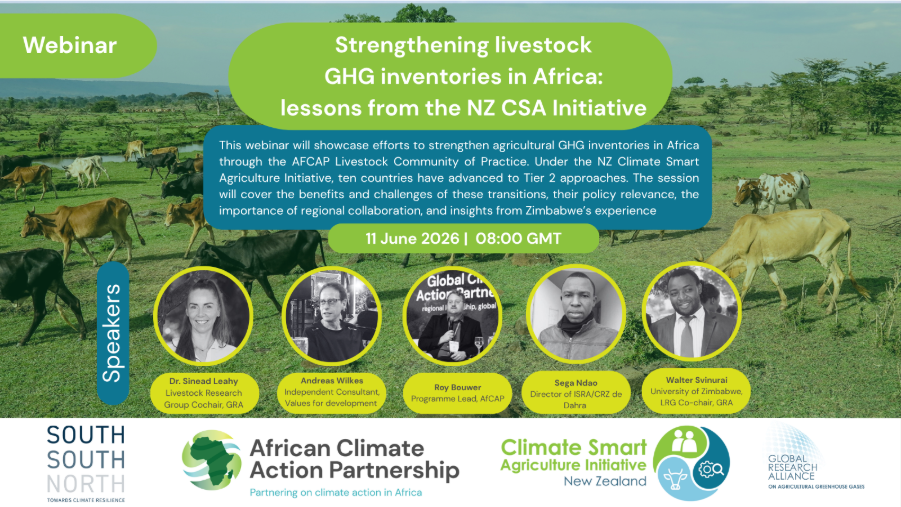
The Global Research Alliance (GRA) & the African Climate Action Partnership (AfCAP) cordially invite you to register for our upcoming webinar on “Strengthening livestock GHG inventories in Africa: Lessons from the NZ CSA Initiative”. This engaging session will bring together inventory and livestock experts, national inventory compilers, researchers, government officials, and development partners involved in agricultural GHG measurement and reporting to gain practical insights into how African countries are strengthening agricultural GHG inventories through Tier 2 approaches. Attendees will also learn about the benefits and challenges of these transitions, their policy relevance, the value of regional collaboration, and hear directly from Zimbabwe’s experience. 

Webinar Overview:   

This session will showcase key capability-building activities in Africa, centred on improving agricultural GHG inventories, and the role of the AFCAP Livestock Community of Practice. Under the NZ Climate Smart Agriculture (CSA) Initiative, technical work in ten countries has moved beyond default emissions estimates to full Tier 2 approaches. The webinar will highlight the practical benefits and challenges of Tier upgrades, their policy relevance, the value of regional collaboration through AFCAP, and insights from the Zimbabwean government.   

Event Details   

Title: Strengthening livestock GHG inventories in Africa: Lessons from the NZ CSA Initiative 

When: 11 June 2026 

Time: 10:00 SAST / 11:00 EAT / 09:00 WAT / 08:00 GMT 

Where: Via Zoom  

REGISTER HERE  

May 29, 2026   •   News

The Global AgriInno Challenge (GAC) 2026 is now accepting applications from innovators worldwide working to transform agrifood systems in Small Island Developing States.

Jointly organized by the Food and Agriculture Organization of the United Nations (FAO), Zhejiang University, and Pinduoduo, this sixth edition of the competition places SIDS at the center of global agrifood innovation, regions that face some of the world’s most pressing climate and food security challenges yet remain underserved by mainstream technology ecosystems.

GAC 2026 is open to agripreneurs and startups from any country, provided their solution directly addresses agrifood challenges facing SIDS or has been deployed within a SIDS context. Teams originating from or led by individuals from SIDS are strongly encouraged to apply.

Thirteen finalists will be selected through a competitive global screening process. Five of these spots are reserved for teams from the twelve SIDS countries participating in the FAO-China South-South Cooperation Project: Bahamas, Barbados, Cabo Verde, Comoros, Cook Islands, Fiji, Grenada, Maldives, São Tomé and Príncipe, Solomon Islands, Trinidad and Tobago, and Vanuatu.

All finalists will travel to Hangzhou, China in August 2026 for an immersive week of expert workshops, investor matchmaking, and the Global Final Pitch before an international jury.

Click HERE for further information.

May 29, 2026   •   News

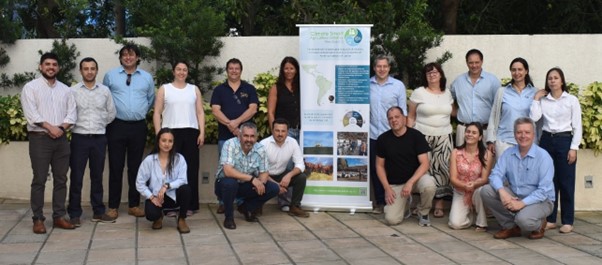
The GANASUR team during a recent Workshop

The GANASUR project – “Developing Mitigation Strategies for the Livestock Sector Through a Collaborative Approach Across the Southern Cone”– is wrapping up in June, but it has positioned the region as a leader in low-emissions livestock approaches in South America.

Funded through the New Zealand Government’s Climate Smart Agriculture Initiative, as part of its contribution to the Global Research Alliance on Agricultural Greenhouse Gases (GRA), and coordinated by PROCISUR, GANASUR brought together leading scientific institutions from Argentina, Brazil, Chile, Paraguay, and Uruguay. This regional collaboration has generated practical evidence that can be used directly by policymakers.

From Fragmented Data to a Shared Evidence Base

A core achievement of GANASUR is the development of harmonised, region-wide “Business-As-Usual” baselines across diverse beef production systems in the Southern Cone. By using consistent methods and verifying typical pastural beef systems, the project created a shared evidence base to enable:

  • robust comparison of mitigation strategies across countries,
  • greater confidence in regional and national emissions estimates, and
  • consistency with international reporting and GRA priorities.

This shared baseline is a critical step toward mitigation actions that can be compared and scaled up. It also allowed the creation of mitigation scenarios, which are useful because they show both the full potential and the realistic pathway for action:

  • Maximum Theoretical Scenario – representing the highest potential mitigation achievable under full implementation of all measures. This helps set ambition and understand the total opportunity.
  • Plausible Scenario – reviewed and agreed by stakeholders within each participating country. This makes it far more relevant for policy design and implementation.

Identifying What Works: Mitigation with Measurable Impact

GANASUR has moved beyond theory to quantify what mitigation options actually deliver across productivity, emissions, and profitability. The project is assessing practical interventions, including:

  • improved reproductive efficiency,
  • optimised grazing and forage systems, with a particular focus on enhancing forage quality (digestibility and nitrogen content) and availability,
  • strategic supplementation, and
  • enhanced animal health management.

Anti-methanogenic feed or additives impacts are evaluated on methane (CH₄) and nitrous oxide (N₂O) emissions up to the farm-gate to ensure that mitigation pathways are grounded in real farm performance.

Linking Science and Policy: The Economics of Mitigation

A key innovation is the development of Marginal Abatement Cost Curves (MACCs) tailored to Southern Cone systems. For each mitigation practice in livestock systems (e.g. better grazing, improved reproduction, feed additives), a MACC answers two key questions:

  1. How much can this reduce emissions? (the abatement potential)
  2. What does it cost to achieve that reduction? (the cost per unit of emissions reduced)

These options are then plotted so you can compare them side by side. These provide policymakers with clear insights into the:

  • cost-effectiveness of mitigation options,
  • trade-offs between emissions reduction and farm profitability, and
  • opportunities for low-cost, high-impact interventions.

This economic lens is essential for designing credible, implementable mitigation policies and investment strategies.

Why GANASUR Matters for the scientific Community

GANASUR delivers exactly what is needed to accelerate progress aligned with the goals of the GRA:

  • Comparable, regionally harmonised data frameworks
  • Evidence on scalable mitigation practices
  • Integration of productivity, resilience, and emissions outcomes
  • Direct relevance for policy and investment decisions

As countries seek to balance food production, economic growth, and emissions reduction, GANASUR provides a replicable model for evidence-based, regionally coordinated climate action in livestock systems.

Its insights will inform policy development, mitigation strategies, and international collaboration, helping ensure that livestock systems in the Southern Cone and beyond are productive, resilient, and aligned with global climate ambitions.

Read more HERE:

Loading Events

Past Featured Events

February 2025

Feed Additives Flagship Project | FNN Webinar

February 24, 2025 @ 11:00 pm - 11:59 pm UTC
|Recurring Event (See all)

One event on February 26, 2025 at 3:00 pm

The Feed Additives Flagship Project, led by the Feed and Nutrition Network (FNN) of the Global Research Alliance on Agricultural Greenhouse Gases and funded by the Global Dairy Platform, has released a groundbreaking collection of Technical Guidelines. The project aims to accelerate the development and implementation of methane-reducing feed additives to significantly reduce greenhouse gases emissions from ruminants. The Technical Guidelines will help scientists and industry leaders develop effective feed additives to mitigate enteric methane emissions. Aiming to cover different…

Find out more »

March 2025

ESPP Workshop: Nutrient Sustainability In The Intensive Livestock Sector

March 5, 2025 @ 8:00 am - March 7, 2025 @ 5:00 pm UTC+1

5-7th March 2025: Phosphorus use and recycling in intensive livestock This event will focus on making livestock production, animal feed, and manure and digestate management more circular. The workshop will help create a UNEP report on sustainable nutrient use in livestock farming.How can we balance efficient nutrient management in intensive livestock farming with social benefits (such as lower prices and regional agri-food specialisation) while tackling nutrient imbalances in certain areas? •    Location: Saint Malo, Brittany (with some sessions online)•   …

Find out more »

OECD webinar: New Zealand’s standardized methodology for estimating farm-level emissions

March 11, 2025 @ 10:30 pm - 11:30 pm NZDT

The OECD is holding a webinar on New Zealand’s standardized methodology for estimating farm-level emissions. Spanish ECOGAN tool for farm-level GHG calculations on Tuesday 11 March from 10:30am to 11:30am Paris time. MPI worked with the agriculture sector to develop a standard way to estimate on-farm greenhouse gas emissions. This methodology was released on 13 December 2024. Currently there are more than 10 emissions calculators, all using different methods to estimate emissions. Our standardized estimation is a key step towards pricing emissions in the future…

Find out more »

Climate and Clean Air Conference 2025

March 16, 2025 @ 8:00 am - March 21, 2025 @ 5:00 pm UTC-3

The Climate and Clean Air Conference 2025 is set to take place from March 16–21, 2025, in Brasília, Brazil. This year’s theme, “Preparing for COP30: Tackling Super Pollutants to Avoid the Catastrophic Overshoot of 1.5°C,” highlights the urgent need for decisive action. The event will bring together country representatives, global experts, and changemakers, united with over 180 partners, to drive accelerated solutions for mitigating super pollutants and safeguarding our planet’s future. This year, we will focus on NDCs 3.0 commitments…

Find out more »

Seminar: Advances in Satellite Monitoring of Methane in Rice in Rice-Growing Regions of Latin America

March 20, 2025 @ 9:00 am - 10:00 am UTC-5

This event is a unique opportunity to learn about the latest innovations and discoveries of this project funded by FontagroLAC and the Global Methane Hub; and executed by INIA - Uruguay, UNALM, ConagroSemillas, FLAR, University of Otago, USDA, and IICAnoticias. There is no registration required. Please use this Teams link to join. Please note that this event will be conducted in Spanish.

Find out more »

Webinar: Implementing innovative technologies: Lessons and opportunities

March 27, 2025 @ 2:30 pm - 3:40 pm CET

The FAO Animal Production and Health Division (NSA) is pleased to invite you to the first webinar in a series leading up to the FAO Global Conference on Sustainable Livestock Transformation in September 2025. This inaugural webinar will explore cutting-edge technological innovations in livestock systems and their potential to enhance productivity, animal welfare, and environmental sustainability. Experts will discuss barriers to adoption and strategies for scaling up solutions worldwide. Draft agenda (Moderator: Xiangyu Song, FAO LEAP Partnership Coordinator) 14:30-14:35Welcoming Remarks - Thanawat Tiensin, FAO Assistant Director-General 14:35-15:05  Keynote…

Find out more »

April 2025

CGIAR Science Week: innovation and partnerships for a food, nutrition, and climate secure-future

April 7, 2025 @ 8:00 am - April 12, 2025 @ 5:00 pm EAT

We are excited to invite you to CGIAR Science Week, now rescheduled for April 7–12, 2025, at the UN Campus in Nairobi, Kenya, co-hosted by the Kenya Agricultural and Livestock Research Organization (KALRO).This special event marks the launch of CGIAR’s 2025–2030 Research Portfolio and offers a dynamic program featuring: As we tackle critical global challenges, this gathering is a chance to collaborate on shaping sustainable food, land, and water systems.Register now to secure your spot and stay updated on event…

Find out more »

May 2025

Webinar: B0 for IPCC inventories and biogas production

May 7, 2025 @ 9:00 am - 10:30 am UTC+2

Join our upcoming webinar! The Manure Management Network of the Global Research Alliance on Agricultural Greenhouse Gases (GRA) will host a webinar on "B0 for IPCC inventories and biogas production". This webinar is on B0, also known as biochemical methane potential, which is an estimate of the maximum possible methane production or emission from a substrate. Measurements of B0 can be used to estimate methane emission from stored liquid manure when combined with a kinetic model. Three researchers with extensive…

Find out more »

Webinar Series: Trade Dialogues on Food

May 12, 2025 @ 2:00 pm - 3:30 pm UTC+2

Please note that there is no registration required for this event, simply scan the QR code to watch the event live. You can send your questions to [email protected] either before or during the dialogue.  We count on your active participation! Related material:  Insights from Trade Dialogues on Food Catalogue of Trade Dialogues on Food  Big Take-Aways Volume I and Volume II For more information see the eFlyer below.

Find out more »

Webinar Series: NZAGRC ‘State of Science’

May 13, 2025 @ 9:00 am - 10:00 am NZST

Our popular webinar series is back in May - register now! We are partnering again with the Irish Teagasc Climate Centre to give you access to the latest research findings. Our first presenters Jane Kay, DairyNZ and Ben Lahart, Teagasc, will delve into the question of “Does seasonality affect how much methane an animal produces?” Understanding methane emissions from cows grazing seasonal pasture is important for accurate accounting of agricultural GHG emissions. Researchers from Ireland and New Zealand are working together to…

Find out more »

Webinar: Nitrogen mineral fertilisers, updates on methodologies and relevant work for inventory improvement

May 16, 2025 @ 8:00 am - 9:10 am NZST

This webinar is aimed to researchers, students and the general public interested in the use of different methodologies to quantify nitrous oxide emissions and ammonia volatilization from agroecosystems, their advantages, and challenges for their implementation. We will also touch on how to use the information generated for national inventories improvement, and we will also provide an update on the development of the N flagship from the GRA. SPEAKERS Mrs Sara Hube, INIA Chile She is chemist, was trained on greenhouse…

Find out more »

Webinar : Global Agenda for Sustainable Livestock 

May 27, 2025 @ 2:00 pm - 3:30 pm UTC+2

The United Nations declared 2024 as the International Year of Camelids (IYC 2024), recognizing the critical role of camelids (camels, llamas, alpacas, vicuñas, guanacos) in food security, livelihoods, and ecosystem resilience, particularly in arid and marginal environments. Throughout the year, GASL knowledge partners have contributed through case studies, outreach events, and policy discussions, showcasing the economic, social, environmental and cultural importance of camelids. This webinar aims to synthesize key findings, share best practices, and discuss common facing challenges and possible…

Find out more »
+ Export Events