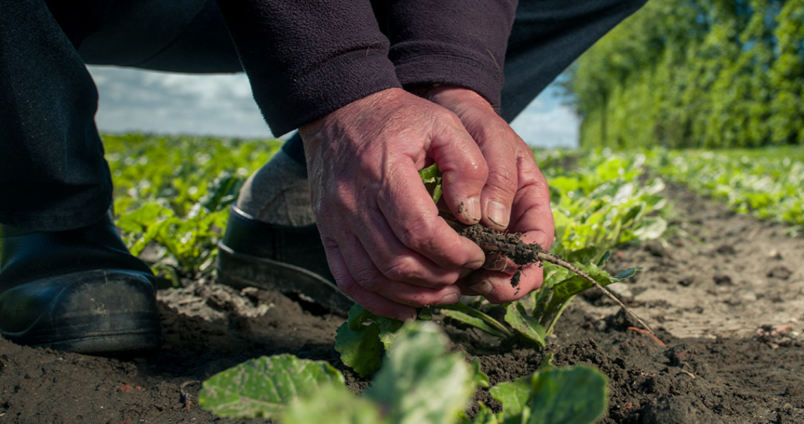
We are excited to announce the Round 7 recipients of Climate, Food and Farming – Global Research Alliance on Agricultural Greenhouse Gases Development Scholarships (CLIFF-GRADS). These PhD candidates from low- and middle-income countries have been selected from a large and highly competitive applicant pool, reflecting their outstanding qualifications and strong potential to advance agricultural climate research.
During 2026 and 2027, these fellows will undertake applied research focused on quantifying and mitigating agricultural greenhouse gas emissions, contributing to more sustainable food systems.
The 40 Round 7 CLIFF-GRADS fellows represent 21 countries from Asia, Africa, Latin America, and the Caribbean. They will carry out research placements at 33 host institutions worldwide.
CLIFF-GRADS offers short-term research placements of 4 to 6 months. These placements give early-career scientists access to specialized equipment, software, and international expertise not available at their home institutions. Fellows contribute to cutting-edge research in areas such as enteric methane, rice systems, soil emissions, and blue carbon ecosystems.
Please follow this LINK to learn about the scholars and research projects they’ll be part of.
One Health in agrifood systems: Recognition for good practices, success stories and innovations in applying the One Health approach
As part of this year’s Global Conference for Actions on One Health in Agrifood Systems, FAO will celebrate best practices and outstanding innovations advancing the One Health approach across agrifood systems. Through this recognition, we will shine a spotlight on pioneering efforts from stakeholders across agrifood systems – showcasing impactful solutions and inspiring future action toward integrated, inclusive, sustainable, and health-oriented agrifood systems.
Objectives
This recognition aims to promote successfully implemented good practices and outstanding innovations in One Health in agrifood systems that have demonstrated significant measurable impact, and to inspire continued innovation through global stakeholder collaboration.
Scope
The Global Conference will recognize practices, success stories and solutions that represent significant advancements or innovations in One Health approaches and sustainable livestock transformation across the entire value chain, successfully implemented at scale in villages, communities, and cities across the world.
These may include new technologies, systems, practices, or solutions that improve efficiency and support action on One Health in agrifood systems and the sustainable transformation of the livestock value chain, encompassing food security, greenhouse gas mitigation, animal health and welfare, antimicrobial resistance, sustainable livestock farming systems, Indigenous Peoples and pastoralist knowledge systems, women and girls empowerment, capacity development for small-scale producers, finance, post-processing, and policy support.
Eligibility
The conference welcomes applications from institutions, international and regional organizations, academic or research entities, civil society groups, and private sector entities. Applications from women, youth, and Indigenous Peoples are particularly encouraged. FAO employees are not eligible to apply.
Selection process
An international panel of experts nominated by FAO will assess the applications, with attention to inclusive and balanced representation across regions, genders, expertise fields, disciplines, and stakeholder groups.
Evaluations will be based on the following criteria:
Impact and practical application: Demonstrated real-world results and effectiveness.
Innovation and originality: Novelty and uniqueness of the proposed approach.
Inclusivity and social impact: Contribution to gender equality, youth engagement, Indigenous communities’ involvement.
Scalability and replicability: Potential for adoption and implementation across diverse contexts and regions.
Sustainability: Contribution to long-term resilience in agrifood systems.
Recognition, demonstration and ceremony
Recipients will receive official recognition at the FAO Global Conference for Actions on One Health in Agrifood Systems, to be held from 21–23 September 2026 at FAO headquarters. A dedicated technical presentation session and innovation pitch talk will be organized as a special event.
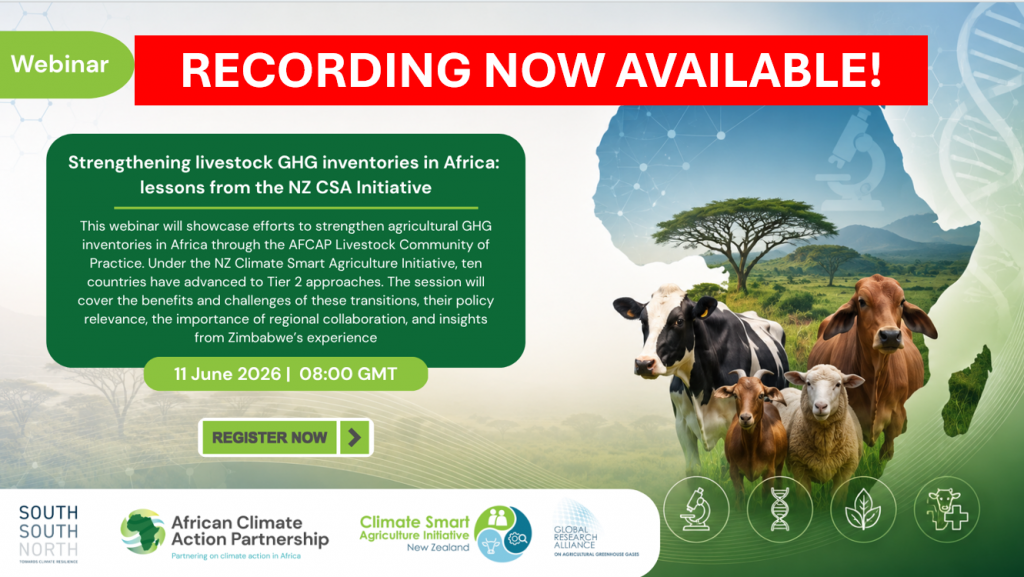
The Global Research Alliance (GRA), the African Climate Action Partnership (AfCAP), and the Government of New Zealand co-hosted this webinar to showcase the achievements of the New Zealand Climate Smart Agriculture (NZCSA) Initiative. The session highlights the initiatives key capability-building efforts across Africa focused on improving agricultural greenhouse gas (GHG) inventories, and the important role of the AfCAP Livestock Community of Practice. Through the NZCSA Initiative, technical work in ten countries has progressed beyond default emissions estimates to more advanced Tier 2 methodologies, enabling more accurate and country-specific data.
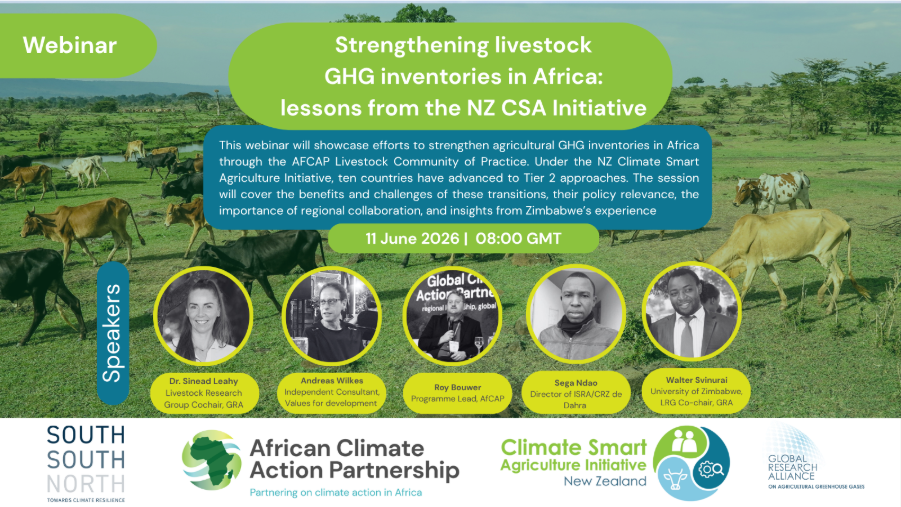
The Speakers
Moderator: Sinead Leahy (Livestock Research Group Co-Chair, GRA) Opening remarks and Context setting
Speaker 1: Andreas Wilkes (Independent consultant, Values for Development Ltd) NZCSA inventory improvement approach and impact across 10 countries
Speaker 2: Walter Svinurai (University of Zimbabwe) Zimbabwe’s progress, policy relevance and regional connections
Speaker 3: Séga Ndao (Director of ISRA/CRZ Dahra – AfCAP/Livestock CoP) Regional Inventory improvement and bilateral exchanges in West Africa
Speaker 4: Roy Bouwer (Programme Lead, South South North) Regional collaboration in Southern and Eastern Africa and the AfCAP Livestock CoP
A video recording of the webinar are now available to view HERE
We’re proud to share the session recordings from the 2026 New Zealand Agriculture and Climate Change Conference!
The recordings cover a wide range of topics, from the latest research and innovation to practical conversations about the opportunities and challenges ahead for reducing agricultural emissions in Aotearoa New Zealand.
The Global Research Alliance (GRA) & the African Climate Action Partnership (AfCAP) cordially invite you to register for our upcoming webinar on “Strengthening livestock GHG inventories in Africa: Lessons from the NZ CSA Initiative”. This engaging session will bring together inventory and livestock experts, national inventory compilers, researchers, government officials, and development partners involved in agricultural GHG measurement and reporting to gain practical insights into how African countries are strengthening agricultural GHG inventories through Tier 2 approaches. Attendees will also learn about the benefits and challenges of these transitions, their policy relevance, the value of regional collaboration, and hear directly from Zimbabwe’s experience.
Webinar Overview:
This session will showcase key capability-building activities in Africa, centred on improving agricultural GHG inventories, and the role of the AFCAP Livestock Community of Practice. Under the NZ Climate Smart Agriculture (CSA) Initiative, technical work in ten countries has moved beyond default emissions estimates to full Tier 2 approaches. The webinar will highlight the practical benefits and challenges of Tier upgrades, their policy relevance, the value of regional collaboration through AFCAP, and insights from the Zimbabwean government.
Event Details
Title: Strengthening livestock GHG inventories in Africa: Lessons from the NZ CSA Initiative
The Global AgriInno Challenge (GAC) 2026 is now accepting applications from innovators worldwide working to transform agrifood systems in Small Island Developing States.
Jointly organized by the Food and Agriculture Organization of the United Nations (FAO), Zhejiang University, and Pinduoduo, this sixth edition of the competition places SIDS at the center of global agrifood innovation, regions that face some of the world’s most pressing climate and food security challenges yet remain underserved by mainstream technology ecosystems.
GAC 2026 is open to agripreneurs and startups from any country, provided their solution directly addresses agrifood challenges facing SIDS or has been deployed within a SIDS context. Teams originating from or led by individuals from SIDS are strongly encouraged to apply.
Thirteen finalists will be selected through a competitive global screening process. Five of these spots are reserved for teams from the twelve SIDS countries participating in the FAO-China South-South Cooperation Project: Bahamas, Barbados, Cabo Verde, Comoros, Cook Islands, Fiji, Grenada, Maldives, São Tomé and Príncipe, Solomon Islands, Trinidad and Tobago, and Vanuatu.
All finalists will travel to Hangzhou, China in August 2026 for an immersive week of expert workshops, investor matchmaking, and the Global Final Pitch before an international jury.
Navigating through climate change with indigenous resilience How can traditional indigenous knowledge deliver global climate change solutions for the future? Learn more about this digital workshop and register by clicking HERE. The agenda is shown below:
Net Zero Carbon: How We Can Meet UK Livestock TargetsVirtual Event On the 3rd of December the British Society of Animal Science (BSAS) and the Centre for Innovation Excellence in Livestock (CIEL), will be joining forces to bring you a day of lively and informative debate, on the topic of meeting UK livestock net zero carbon targets. Climate change is the greatest environmental challenge currently facing our planet and the way we live. Addressing this will require concerted and coordinated…
Join the NZAGRC State of Science webinar on 6 December 2021 to learn more about "Developing methane inhibitors for grazing livestock on New Zealand farms". Methane inhibitors or feed additives offer a real opportunity to lower emissions by reducing the activity of methane-producing microbes in the digestive systems of ruminant livestock. This mitigation strategy is most effective when the additive is in every mouthful of feed and can reduce methane produced during rumen fermentation. However, daily administration comes at a…
Join the Croplands Research Group on 7 December to hear Dr. Anastasia Pantera, from the Agricultural University of Athens (AUA), present on the topic "Mediterranean agroforestry and climate change". Please complete this short form to register and have access to the platform.
December 9, 2021 @ 1:30 am - December 10, 2021 @ 5:00 am NZDT
Farmers, policymakers, companies, and other stakeholders will discuss the future of carbon farming during the conference ‘Incentivising carbon farming’. Get your free ticket now for the online plenary program on December 8th, and for one or more online workshops on December 9th. A consortium of Dutch, Flemish, German, and Norwegian partners started four years ago to develop the Carbon Farming project. Farmers have the perfect position to deliver a positive impact on our climate challenges and the climate goals that…
The Croplands Research Group of the Global Research Alliance is thrilled to present the next Croplands Research Group Annual Meeting! Registrations will be open until 7 January 2022. If you have not received an email with a link to register, please email [email protected] to request a registration link.
The Global Forum for Food and Agriculture (GFFA) is an international conference on central issues of vital importance for global agricultural and food policies. Due to the COVID-19 pandemic that has not yet been overcome worldwide, the GFFA will once again take place in a virtual format. The GFFA is hosted by the Federal Ministry of Food and Agriculture (BMEL) in cooperation with the Berlin Senate, Messe Berlin GmbH and GFFA Berlin e.V. The five-day forum features a large number…
This is a Climate-Soil Community of Practice Meeting. After our last insightful event in October this year, we will follow up with another event on incentives in January 2022. This time the focus will be on the linkages between policy interventions and SOC increase. The event will start with two keynote speeches and afterwards it’s time for you to get involved! We invite you to present projects and exchange on experiences regarding policy interventions, that helped carbon sequestration in agriculture.…
One of the Circular Food Systems Network’s objectives is to support collaboration, share knowledge and connect researchers from all over the world. During the 2021 CFS Network kick-off workshop, several new collaborations to research circularity in different food systems around the world emerged. On 28th January 2022, four case study leaders will share their approach, first insights and questions they have. It is an informal meeting, in which exchange between the case studies is key. We would like to invite…
The Alliance of Bioversity and CIAT, Multifunctional Landscapes Research Area, and OneCGIAR invite you to attend the webinar 'Building a vision for achieving net-zero food systems by 2050' on 28 January at 5:30 pm CET (11:30am EST/ 5:30am NZ/ 10:00pm Delhi). The purpose of this webinar is to put into perspective major actions towards a vision for achieving net-zero food systems by 2050. A panel of representatives from global food system companies, value-chains and finance communities are brought together by…
Join the Manure Management Network on 16 February from 08:00 - 10:00 (CET) for a webinar titled "Development of bio-based fertilisers for a circular bioeconomy". Speakers: • Patrick Forrestal, Teagasc, Ireland• Laia Llenas Argelaguet, UVIC-UCC, Spain• Lars Stoumann Jensen, University of Copenhagen, Denmark Plus time for Q&A. REGISTER NOW BY CLICKING HERE. Agenda below:
Registrations are now open for the 2022 Global Research Alliance Council Meeting. If you have not received an email with a link to register, please email [email protected] to request a registration link.