
We have a new report celebrating the highlights of the GRA , available to download and share. Check it out HERE.
World Bank
Latest News
The Global Research Alliance on Agricultural Greenhouse Gases (GRA) is very pleased to welcome El Salvador who joined us in June 2026 as our newest Member Country!
El Salvador’s participation in the GRA will be coordinated through the Ministry of Agriculture and Livestock (MAG), with its national focal point based at Centro Nacional de Tecnología Agropecuaria y Forestal (CENTA).
El Salvador recognises the importance of strengthening international cooperation, the exchange of scientific knowledge, and technological innovation aimed at reducing greenhouse gas emissions from the agricultural sector.
El Salvador considers participation in the Alliance to be a valuable opportunity to strengthen national capacities in research, mitigation, and adaptation to climate change, particularly in areas related to sustainable agriculture, soil management, resilient livestock systems, agroforestry systems, and food security.
Likewise, the country reaffirms its commitment to international climate action efforts, in line with the Paris Agreement and national priorities linked to sustainable development and climate resilience in the agricultural sector.
We warmly welcome El Salvador and look forward to their contributions to the GRA.
We are excited to announce the Round 7 recipients of Climate, Food and Farming – Global Research Alliance on Agricultural Greenhouse Gases Development Scholarships (CLIFF-GRADS). These PhD candidates from low- and middle-income countries have been selected from a large and highly competitive applicant pool, reflecting their outstanding qualifications and strong potential to advance agricultural climate research.
During 2026 and 2027, these fellows will undertake applied research focused on quantifying and mitigating agricultural greenhouse gas emissions, contributing to more sustainable food systems.
The 40 Round 7 CLIFF-GRADS fellows represent 21 countries from Asia, Africa, Latin America, and the Caribbean. They will carry out research placements at 33 host institutions worldwide.
CLIFF-GRADS offers short-term research placements of 4 to 6 months. These placements give early-career scientists access to specialized equipment, software, and international expertise not available at their home institutions. Fellows contribute to cutting-edge research in areas such as enteric methane, rice systems, soil emissions, and blue carbon ecosystems.
Please follow this LINK to learn about the scholars and research projects they’ll be part of.

December 2022
Webinar: Implementing climate action through peatlands
Join Wetlands International and their collaborators for the 2nd session in their webinar series on peatlands and climate commitments. The webinar will discuss how to implement peatland-related climate commitments (including those contained in NDCs and LTS), empowering countries to implement climate action in peatland landscapes, taking into account the many tools and resources available, good practices and lessons learned. Case examples from different regions will be presented. There will also be an ‘Ask the Expert’ space allocated, where you will…
Find out more »Webinar: ReGenerative Grazing as a Soil, Climate, and Livelihoods Solution
Join the international “4 per 1000” Initiative and their partners from Soil4Climate for their upcoming webinar titled “ReGenerative Grazing as a Soil, Climate, and Livelihoods Solution: The Science, Practice and Policy” on Wednesday 14 December at 17:00 UTC. The event will look at the science, practices and policies of regenerative grazing as a soil, climate, and livelihoods solution. Particular attention will be given to grasslands, soils, and pastoral people and agriculturally dependent communities. You can find the Zoom link and…
Find out more »January 2023
Joint CRG & IRG Meeting
The GRA Croplands and Integrative Research Group are holding a joint meeting in Seville, Spain on the 17th and 18th of January 2023. The joint meeting will be held before the IX Congreso Internacional de Agroecología in Seville, Spain, which runs from 19-21 January 2023. The abstract submission deadline is 15 October 2022. The IX Congreso Internacional de Agroecología will have sessions in any of the following languages: English, Portuguese and Spanish, but without simultaneous translation. This is an invitation…
Find out more »February 2023
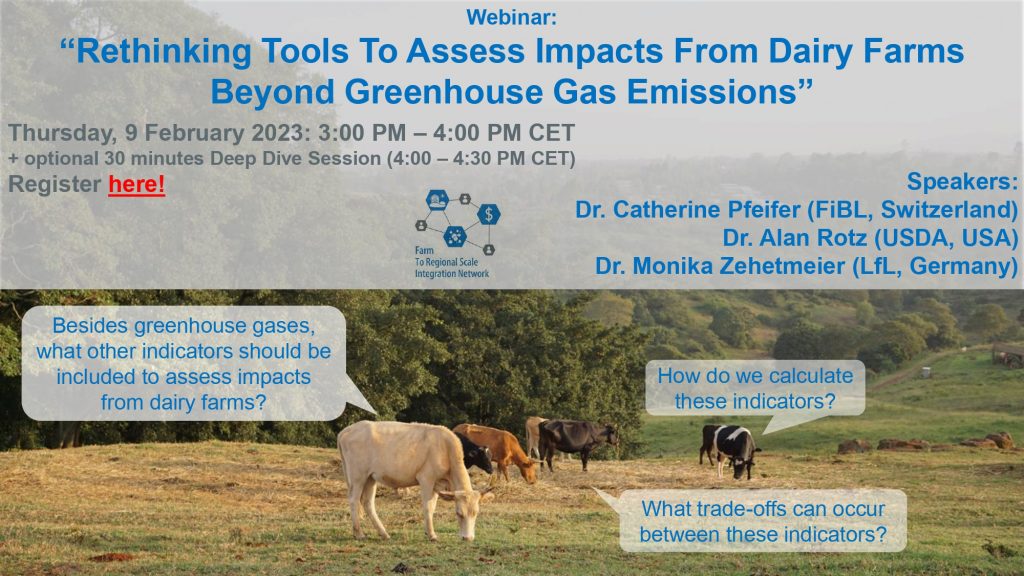
Webinar: “Rethinking Tools To Assess Impacts From Dairy Farms Beyond GHG Emissions”
The GRA Farm to Regional Scale Integration Network are very happy to invite you to their upcoming webinar on the topic “Rethinking Tools To Assess Impacts From Dairy Farms Beyond Greenhouse Gas Emissions”: Date: Thursday, 9th February 2023 Hours: 15.00 – 16.00 CET (GMT+1) Registration link: https://thuenen.webex.com/weblink/register/r5f531793c543000711c641cda7d2a586 Agenda: After the webinar, we are offering an optional 30 minutes Deep Dive Session (16.00 – 16.30 CET) with some of the speakers to discuss further open questions. We are very much looking forward to welcoming many…
Find out more »2023 CaSSECS annual meeting
The programme for the 2023 CaSSECS annual meeting (to be held in Niamey, Niger) can be found below. If you would like to attend the meeting, or would like further information, please contact Anaïs Boury-Esnault.
Find out more »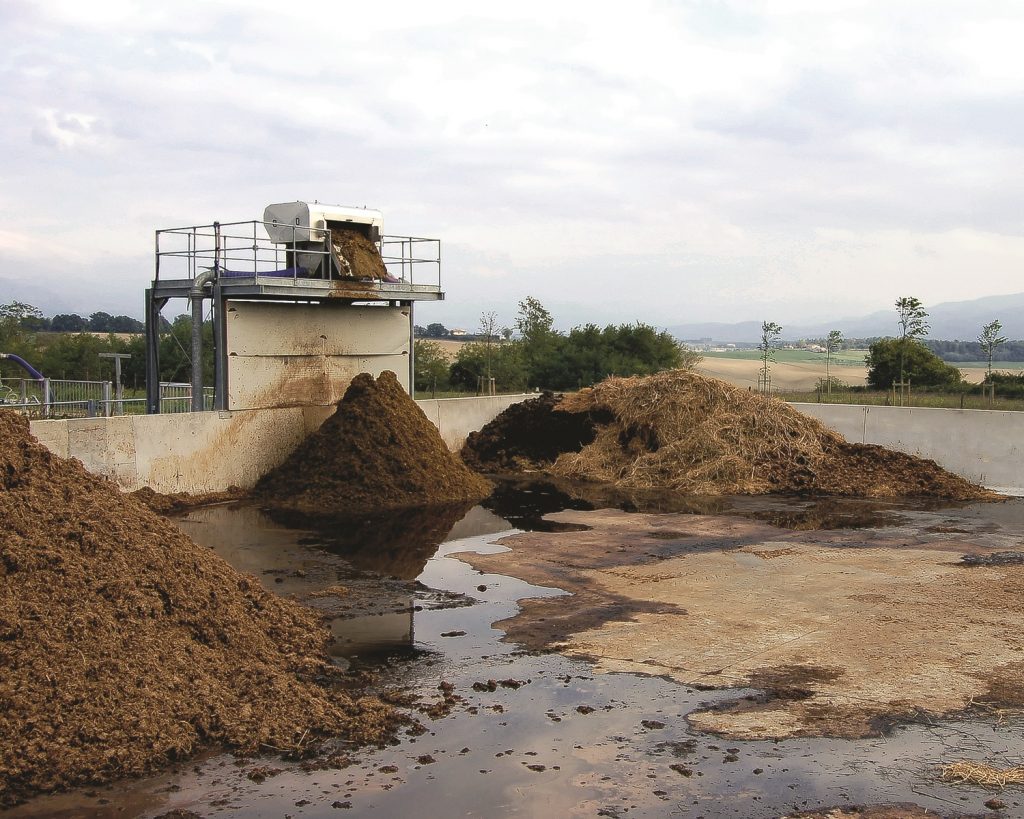
Webinar: Methane emissions from manure management – monitoring and mitigation
In this webinar, Anne Mottet (FAO), Dong Hongmin (Chinese Academy of Agricultural Sciences) and Andrew Vanderzaag (Agriculture & AgriFood Canada) will first present global trends in livestock production and methane emissions, and discuss methods of monitoring, mitigation and accounting. A new approach for estimation of methane emissions from manure management via measurements and an empirical model will then be introduced. This methodology was investigated in the ERA-Net project M4Models and will be presented by Søren O. Petersen and Paria Seefedpari.
Find out more »
New Zealand Agricultural Climate Change Conference 2023
The New Zealand Agricultural Climate Change Conference and associated meetings will be held from 28 February thru 2 March 2023 at Te Papa, Wellington. The two-day conference will showcase the latest research and policy developments and implementation actions being undertaken to reduce agricultural greenhouse gases in New Zealand. The conference is aimed at primary sector, science and government leaders and practitioners interested in agricultural greenhouse gas and climate change developments and the latest research on reducing agricultural greenhouse gas emissions. Updates will be posted on the NZAGRC website.
Find out more »March 2023
Webinar: Assessing the Greenhouse Gas Impacts of Agriculture Policies
ICAT and GHGMI invite you to a webinar on the ICAT Agriculture Methodology: Assessing the Greenhouse Gas Impacts of Agriculture Policies When: 16 March 2023 Time: 08:00-09:30 Eastern Standard / 14:00-15:30 Central European /16:00-17:30 East African / 21:00-22:30 China Standard Time Open to all interested persons, including representatives of governments and their partners involved in planning, implementing, and/or assessing greenhouse gas emissions in the context of producing national low-carbon strategies or meeting their commitments to the Paris Agreement. Registration now…
Find out more »Webinar: Putting smallholder farmers at the center of sustainable food systems
Information shared on behalf of GRA Partner, Environmental Defense Fund: Smallholder farmers represent 80% of farmers in North Africa. They have a fundamental role in delivering sustainable food systems, but as underscored by the Food and Agriculture Organization, many experience poverty, food insecurity, and limited access to markets and services. In this webinar hosted by Danone Ecosystem, we will provide you with concrete examples of North African projects, including H’lib Bladi in Morocco, Alban Baladna in Egypt, and H'lib Dzair…
Find out more »Webinar: Assessing Soil Carbon in Global Grasslands
A FAO webinar on "Assessing Soil Carbon in Global Grasslands: The Importance of Sustainable Livestock Practices" will be held on Wednesday, 29 March from 14.00 to 15.30 (Rome time). The event presents the key findings of the first FAO Global Assessment of Soil Carbon in Grasslands and shares insights on the state of soil carbon stocks in grassland systems in the world. Register here: https://fao.zoom.us/webinar/register/WN_srZvc-1fQyWrDh0WHQRDDw
Find out more »April 2023
RTD Series on Sustainable Food and Agriculture Systems in Southeast Asia
This hybrid event will be held at the Philippine International Convention Center (PICC), Manila, Philippines and livestreamed via Zoom and Facebook.SEARCA and Bangko Sentral ng Pilipinas (BSP) are jointly organizing the RTD Series, which will discuss the current state of digital economies in agriculture, the status of carbon farming in Southeast Asia, the challenges and opportunities in the field, and the role that technology and innovation can play in creating a more sustainable future. The onsite participants are by invitation only. Virtual participants are invited to register…
Find out more »Webinar: Regional support to national livestock GHG inventories in Southern Africa
Regional support to national livestock Greenhouse Gas (GHG) inventories in Southern Africa: key lessons from the regional inventory compilation approach FANRPAN, the University of Pretoria, the New Zealand Agricultural Greenhouse Gas Research Centre, and the Africa LEDS Partnership invite you to a special webinar dedicated to sharing lessons and experiences from their Regional Tier 2 Inventory Compilations from Botswana, Eswatini, Lesotho, and Mozambique. The Southern African Development Community (SADC) countries recognize the need for adaptation to climate change and mitigation…
Find out more »