The Global Research Alliance on Agricultural Greenhouse Gases (GRA) is very pleased to welcome El Salvador who joined us in June 2026 as our newest Member Country!
El Salvador’s participation in the GRA will be coordinated through the Ministry of Agriculture and Livestock (MAG), with its national focal point based at Centro Nacional de Tecnología Agropecuaria y Forestal (CENTA).
El Salvador recognises the importance of strengthening international cooperation, the exchange of scientific knowledge, and technological innovation aimed at reducing greenhouse gas emissions from the agricultural sector.
El Salvador considers participation in the Alliance to be a valuable opportunity to strengthen national capacities in research, mitigation, and adaptation to climate change, particularly in areas related to sustainable agriculture, soil management, resilient livestock systems, agroforestry systems, and food security.
Likewise, the country reaffirms its commitment to international climate action efforts, in line with the Paris Agreement and national priorities linked to sustainable development and climate resilience in the agricultural sector.
We warmly welcome El Salvador and look forward to their contributions to the GRA.
We are excited to announce the Round 7 recipients of Climate, Food and Farming – Global Research Alliance on Agricultural Greenhouse Gases Development Scholarships (CLIFF-GRADS). These PhD candidates from low- and middle-income countries have been selected from a large and highly competitive applicant pool, reflecting their outstanding qualifications and strong potential to advance agricultural climate research.
During 2026 and 2027, these fellows will undertake applied research focused on quantifying and mitigating agricultural greenhouse gas emissions, contributing to more sustainable food systems.
The 40 Round 7 CLIFF-GRADS fellows represent 21 countries from Asia, Africa, Latin America, and the Caribbean. They will carry out research placements at 33 host institutions worldwide.
CLIFF-GRADS offers short-term research placements of 4 to 6 months. These placements give early-career scientists access to specialized equipment, software, and international expertise not available at their home institutions. Fellows contribute to cutting-edge research in areas such as enteric methane, rice systems, soil emissions, and blue carbon ecosystems.
Please follow this LINK to learn about the scholars and research projects they’ll be part of.
One Health in agrifood systems: Recognition for good practices, success stories and innovations in applying the One Health approach
As part of this year’s Global Conference for Actions on One Health in Agrifood Systems, FAO will celebrate best practices and outstanding innovations advancing the One Health approach across agrifood systems. Through this recognition, we will shine a spotlight on pioneering efforts from stakeholders across agrifood systems – showcasing impactful solutions and inspiring future action toward integrated, inclusive, sustainable, and health-oriented agrifood systems.
Objectives
This recognition aims to promote successfully implemented good practices and outstanding innovations in One Health in agrifood systems that have demonstrated significant measurable impact, and to inspire continued innovation through global stakeholder collaboration.
Scope
The Global Conference will recognize practices, success stories and solutions that represent significant advancements or innovations in One Health approaches and sustainable livestock transformation across the entire value chain, successfully implemented at scale in villages, communities, and cities across the world.
These may include new technologies, systems, practices, or solutions that improve efficiency and support action on One Health in agrifood systems and the sustainable transformation of the livestock value chain, encompassing food security, greenhouse gas mitigation, animal health and welfare, antimicrobial resistance, sustainable livestock farming systems, Indigenous Peoples and pastoralist knowledge systems, women and girls empowerment, capacity development for small-scale producers, finance, post-processing, and policy support.
Eligibility
The conference welcomes applications from institutions, international and regional organizations, academic or research entities, civil society groups, and private sector entities. Applications from women, youth, and Indigenous Peoples are particularly encouraged. FAO employees are not eligible to apply.
Selection process
An international panel of experts nominated by FAO will assess the applications, with attention to inclusive and balanced representation across regions, genders, expertise fields, disciplines, and stakeholder groups.
Evaluations will be based on the following criteria:
Impact and practical application: Demonstrated real-world results and effectiveness.
Innovation and originality: Novelty and uniqueness of the proposed approach.
Inclusivity and social impact: Contribution to gender equality, youth engagement, Indigenous communities’ involvement.
Scalability and replicability: Potential for adoption and implementation across diverse contexts and regions.
Sustainability: Contribution to long-term resilience in agrifood systems.
Recognition, demonstration and ceremony
Recipients will receive official recognition at the FAO Global Conference for Actions on One Health in Agrifood Systems, to be held from 21–23 September 2026 at FAO headquarters. A dedicated technical presentation session and innovation pitch talk will be organized as a special event.
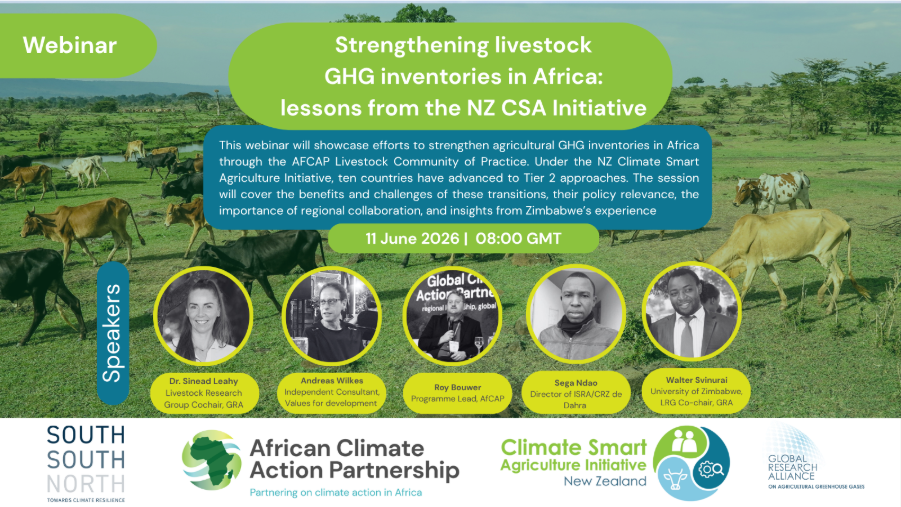
The Global Research Alliance (GRA), the African Climate Action Partnership (AfCAP), and the Government of New Zealand co-hosted this webinar to showcase the achievements of the New Zealand Climate Smart Agriculture (NZCSA) Initiative. The session highlights the initiatives key capability-building efforts across Africa focused on improving agricultural greenhouse gas (GHG) inventories, and the important role of the AfCAP Livestock Community of Practice. Through the NZCSA Initiative, technical work in ten countries has progressed beyond default emissions estimates to more advanced Tier 2 methodologies, enabling more accurate and country-specific data.
The Speakers
Moderator: Sinead Leahy (Livestock Research Group Co-Chair, GRA) Opening remarks and Context setting
Speaker 1: Andreas Wilkes (Independent consultant, Values for Development Ltd) NZCSA inventory improvement approach and impact across 10 countries
Speaker 2: Walter Svinurai (University of Zimbabwe) Zimbabwe’s progress, policy relevance and regional connections
Speaker 3: Séga Ndao (Director of ISRA/CRZ Dahra – AfCAP/Livestock CoP) Regional Inventory improvement and bilateral exchanges in West Africa
Speaker 4: Roy Bouwer (Programme Lead, South South North) Regional collaboration in Southern and Eastern Africa and the AfCAP Livestock CoP
A video recording of the webinar are now available to view HERE
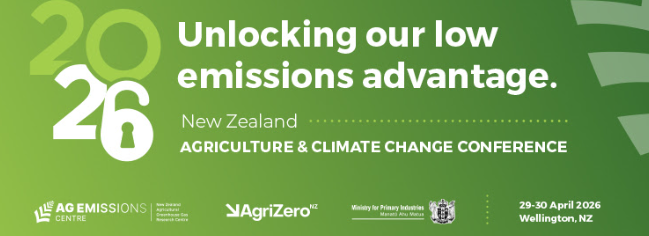
We’re proud to share the session recordings from the 2026 New Zealand Agriculture and Climate Change Conference!
The recordings cover a wide range of topics, from the latest research and innovation to practical conversations about the opportunities and challenges ahead for reducing agricultural emissions in Aotearoa New Zealand.
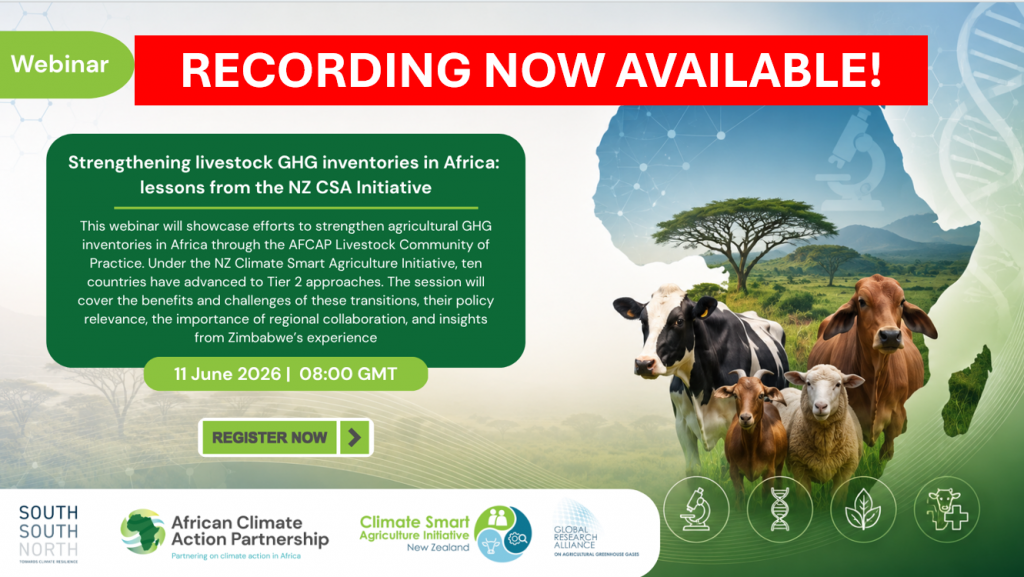
The Global Research Alliance (GRA) & the African Climate Action Partnership (AfCAP) cordially invite you to register for our upcoming webinar on “Strengthening livestock GHG inventories in Africa: Lessons from the NZ CSA Initiative”. This engaging session will bring together inventory and livestock experts, national inventory compilers, researchers, government officials, and development partners involved in agricultural GHG measurement and reporting to gain practical insights into how African countries are strengthening agricultural GHG inventories through Tier 2 approaches. Attendees will also learn about the benefits and challenges of these transitions, their policy relevance, the value of regional collaboration, and hear directly from Zimbabwe’s experience.
Webinar Overview:
This session will showcase key capability-building activities in Africa, centred on improving agricultural GHG inventories, and the role of the AFCAP Livestock Community of Practice. Under the NZ Climate Smart Agriculture (CSA) Initiative, technical work in ten countries has moved beyond default emissions estimates to full Tier 2 approaches. The webinar will highlight the practical benefits and challenges of Tier upgrades, their policy relevance, the value of regional collaboration through AFCAP, and insights from the Zimbabwean government.
Event Details
Title: Strengthening livestock GHG inventories in Africa: Lessons from the NZ CSA Initiative
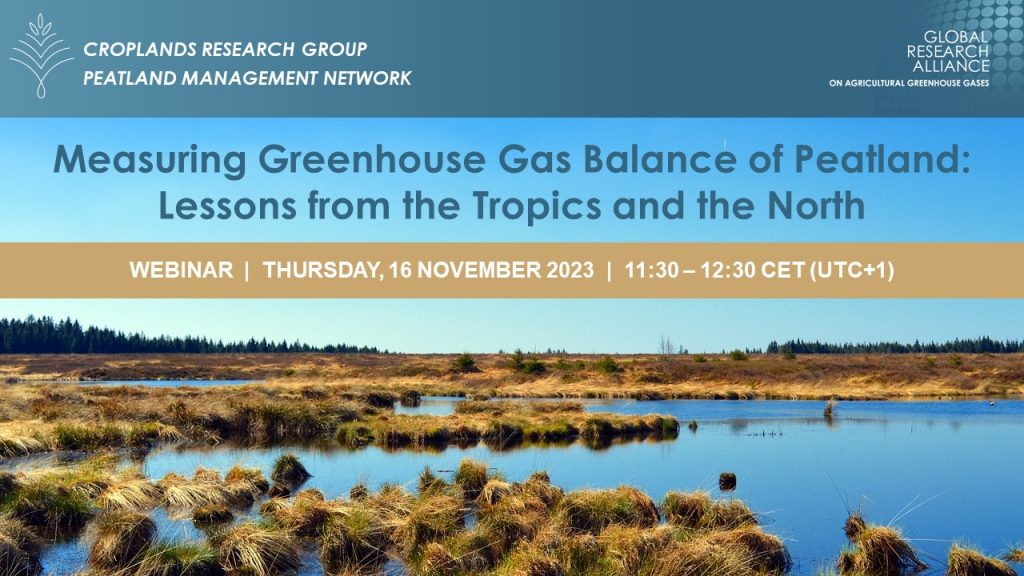
Join the GRA Peatland Management Network on 16 November at 11:30 (CET) for a webinar titled "Measuring Greenhouse Gas Balance of Peatland: Lessons from the Tropics and the North". There will be two presentations by global experts on measuring GHG balance of peatlands followed by time for Q&A. Speakers: Net greenhouse gas balance from several land covers of Indonesian peatlandPresented by: Prof. Dr. Fahmuddin Agus, National Research and Innovation Agency (BRIN), Indonesia Peatland greenhouse gas observation needs and an example…
This event is organised by the ORCaSa project. Just over a year after the start of the ORCaSa project, it's time to officially launch the Soil Carbon International Research Consortium (IRC)! We look forward to seeing you in Madrid (Spain) on 21 November to mark this event together, which is being organised during the first edition of the European Mission Soil Week. During the hour-long session, the services provided and key information on IRC governance will be presented. There will…
The GFFA 2024 aims at deepening and strengthening the agri-political dialogue. Around 2000 policymakers, scientists, business leaders and members of civil society will seize the opportunity to discuss and connect. Many GFFA events are public, among them 3 High Level Panek, 16 expert panel, a science slam and the opening ceremony. The work of the GRA will be showcased in two expert panels at the GFFA in Berlin next year. GRA, The Power of Inclusivity: Indigenous-led measures to reduce the…
Hear from the GRA’s Africa Programme Director, Dr Ackim Mwape at this webinar on climate change and trade. The aim of the World Trade Organization’s (WTO) Trade Dialogues on Food is to create a conversation around the role of international trade in food security. The Trade Dialogues on Food invite experts from governments, non-governmental organizations, businesses, academia, think tanks and foundations, to debate the most topical issues in food trade. Each year the international trading system moves enough wheat, maize,…
Join the GRA Croplands Research Group & AGMIP for their upcoming webinar titled "Co-benefits & tradeoffs of agricultural mitigation and adaptation in rice-based cropping systems". Presentations will be followed by time for Q&A. Speakers:Roberto Valdivia (Oregon State University, USA)Sonali McDermid (New York University, NASA-GISS, USA)Tao Li (International Rice Research Institute, IRRI, Philippines)Erik Mencos (Columbia University, NASA-GISS, USA) This webinar is online.
Join Us in the NetherlandsVan der Valk Hotel Sassenheim - Leiden, NL There’s still time to be part of the Pathways to Dairy Net Zero (P2DNZ) Animal Nutrition Workstream and its in-person workshop in the Netherlands on April 22-24. Please register here by April 5.Agenda Overview View the detailed tentative agenda. Hotel AccommodationsA block of rooms is being held until March 21 at the Van der Valk Hotel, where the workshop will be held. The negotiated rate is €189,00/night. To reserve…
The ORCaSa project is holding a joint online workshop with MARVIC project One workshop, two dates - Online The workshop will be held once on April 24th (starting at 4pm in Sydney, 1pm in Hanoi, 9am in Harare and 8am in Paris) for the stakeholders from the Pacific/Asian/ African/European regions. It will be organised a second time on April 25th (starting at 4pm in Paris, 9am in Colorado, 11 am in Sao Paulo, 5 pm in Harare) for the stakeholders from the South-America/North America/Africa/Europe regions. For three hours, you will join…
Webinar on environmental inhibitors in agrifood systems. Discover how these practices balance sustainability and efficiency while addressing food safety concerns. Let's discuss strategies for managing residues and closing regulatory gaps for a safer, more sustainable future. Please find attached the agenda for a FAO-organised webinar to discuss the findings from its recent publication Food safety implications from the use of environmental inhibitors in agrifood systems (fao.org). Representatives from NZ, Chile, the UK FSA and the US FDA will be panelists in…
16 May 2024, 14:00-15:00 CEST - Agricultural Methane - CCAC M-RAP NDC Enhancement Opportunities and Examples Workshop 2024 M-RAP Virtual Workshop Series (event page) The Methane Roadmap Action Programme (M-RAP) built from the decade-long experience and methodology of the CCAC's National Planning process and support development and implementation of transparent and consistent national methane roadmaps.This M-RAP NDC Enhancement webinar series provides countries with concrete and practical guidance for how to leverage the M-RAP methodology tools and resources of the CCAC to enhance their…
May 28, 2024 @ 8:00 am - May 29, 2024 @ 5:00 pm NZST
Event Details: Session 1: May 28th (5 pm CET, 8 am PST, 11 pm CST, 2 am AEST) Session 2: May 29th (9 am CET, 12 am PST, 3 pm CST, 5 pm AEST) Objectives: Traditional vs. Advanced Approaches: Explore the evolution of rumen microbe culture techniques, from traditional methods to cutting-edge advancements. Learn about recent breakthroughs in the field. Overcoming Cultivation Challenges: Address the obstacles hindering rumen microbe cultivation and identify the resources available to overcome them. Agenda: Check…
2 ONLINE SESSIONS:4 & 6 June 2024 The ORCaSa team is organising a webinar to present Impact4Soil, an online knowledge tool aimed at a range of professionals and experts from the research community, but also the private sector, NGOs, policy-makers, and anyone with an interest in the health of our soils. Soil is a global subject of study, and Impact4Soil will enable synergies and collaborations by bringing together researchers, farmers, foresters, spatial planners, land managers. Stated simply, the platform will cover any type of soil…
The International Temperate Rice Conference will be held June 5-8, 2024, at the Marriott Hotel on Canal Street in New Orleans, Louisiana, USA. This is a continuation of the very successful scientific meetings that have been held since the first in New South Wales, Australia in 1994. The meeting will be jointly hosted by the Louisiana State University Agricultural Center (LSU AgCenter) and the USA Rice Federation. The meeting will have scientific presentations, posters, etc. on June 6 & 7…