
Being a successful scholar today requires scientists to deliver their insights beyond the academic community and show that their research has real-world value. But how can scientists better communicate their research, data and analysis? We ask this question in the first part of the 2022 CLIFF-GRADS Science Collaboration series and seek answers together with science communications experts.
The online event series kicked off with speaker Jonathan Schwabish, an economist and science communications expert at the Urban Institute, who shared his insights about the fundamentals of an effective science communication strategy. The topics he covered included content hierarchy, strategic planning, and audience analysis. He recently published the book “Elevate the debate: A multi-layered approach to communicating your research”, which served as the basis for discussions at the first session of our event series. This blog provides an overview of the main points from the event.
The September/October 2021 edition of the Soil Science Society of America Journal (SSSAJ) features a special section titled “The Role of Conservation Agricultural Practices on Reducing Greenhouse Gas Emissions and Enhancing C Sequestration“.
The section brings together studies from across the globe and was edited by Craig Drury (Agriculture & Agri-Food Canada, Ontario Canada), Chuck Rice (Kansas State University, Kansas USA) and Jane Johnson (United States Department of Agriculture, Minnesota, USA). The editors had the idea for a SSSAJ special section in 2019 at the Global Research Alliance’s (GRA) meeting of the Croplands Research Group and implementation has been led by the Conservation Agriculture Network.
Ten peer-reviewed papers are published in the special section. They include seven field studies, two modeling studies (using field data), and one meta-analysis paper. The conservation agriculture (CA) practices covered in these manuscripts include conservation tillage, crop rotations, cover crops, and residue management. Several studies include a combination of CA practices (e.g., two papers included both tillage and residue management treatments). The research represents field sites in four countries (United States, Canada, Argentina, and Denmark) across three continents (North and South America and Europe). The meta-analysis study uses published data from 121 field sites in 19 countries across six continents. Collectively, these articles provide examples of CA benefits related to reducing N2O emissions and enhancing C sequestration in soils.
We are pleased to announce a new in-depth assessment of ten leading compounds being studied for efficacy to methane mitigation in ruminant livestock. The analysis assesses the most promising compounds for mitigating ruminant methane emissions.
The report aims to inform policymakers, industry investors and feed industry advisers on the effectiveness, applicability, and broader commercial issues surrounding methane reducing feed additives.
This concise resource can guide investment and management decisions by all actors in the livestock supply chain.
Key findings of the 10 reviewed additive groups
- Only two additives (3-Nitrooxypropanol) and dried Asparagopsis (red algae) have routinely delivered over 20% mitigation of enteric methane by the consuming ruminants. Dietary nitrate is the third most effective additive and can safely deliver 10% or more mitigation when consumed. The other classes of additive cannot be expected to deliver 10% mitigation when fed.
- Two major constraints for all reviewed additives achieving substantial global impact on livestock emissions in the immediate future, include:
- Insufficient evidence to show any of these additives will increased production while decreasing methane output.
- Almost all studies relied on additives mixed into a total mixed ration. There is almost no evidence of the efficacy of administering additives as a supplement, as in rangeland systems.
- Further research is needed to establish a business case for on-farm use of these additives.
- A small survey of the actors in the feed additive pipeline from the manufacturers through feed millers to livestock managers, shows:
- A poor understanding of the efficacy and co-benefits of potential additives.
- All livestock managers recognized they need more information on additives.
- No additive manufacturers identified the grazing industry as a high priority market for a methane mitigating product.
Please share with your networks!
Title: “Fate of antibiotic residues and antibiotic resistant bacteria in livestock manure and their effects on greenhouse gas emissions and nutrient cycling”
Closing Date: Monday, 31 January 2022
Learn more HERE.
About the position:
Imprudent use of antibiotics is increasing in livestock production systems in low- and middle-income countries, with potentially severe consequences for human, animal, and environmental health. However, little is known about the fate of antibiotic residues in livestock manure in smallholder farm settings under traditional manure management systems. Bacteria that are resistant to antibiotics can spread into and across the environment through livestock manure, posing a health hazard that needs to be addressed. In addition, livestock manure is a source of greenhouse gas (GHG) emissions that contribute to global warming. To achieve sustainable livestock development pathways in East Africa, it is important to understand the impact of livestock production on the environment (GHG emissions as well as animal and human health impacts).
Despite potentially negative aspects of livestock manure, it is an important resource for smallholder farmers. It can be used as crop fertilizer, thereby reducing the need for expensive synthetic fertilizer, and is beneficial for soil fertility and stability. Understanding if and how antibiotic residues and antibiotic-resistant bacteria affect nutrient cycling during manure storage and field application is critical. Because GHGs are formed during microbially-mediated processes, the presence of antibiotic residues and resistant organisms can influence the magnitude of GHG emissions and the fertilizer quality of the manure. Manure management practices that both reduce antibiotic resistance and GHG emissions and are practical for smallholder farmers are urgently needed to stop the spread of AMR and to mitigate climate change.
To address these research gaps, ILRI seeks to recruit a PhD graduate fellow to investigate how the presence of antibiotic residues and antibiotic resistant bacteria affect GHG emissions and nutrient cycling in manure in different livestock production systems in Kenya, and how manure management interventions can help to reduce both GHG emissions and antibiotic resistance. To answer these research questions, the candidate will conduct a series of lab and on-farm experiments. The gained knowledge will help to prioritize good livestock adaptation and mitigation options in relevant livestock systems and help to build capacity in decision support and planning in East Africa.
Learn more HERE.
A recording of the December 2021 Croplands Research Group Webinar, titled “Mediterranean agroforestry and climate change”, is now available to view.
This webinar session featured a presentation from Dr. Anastasia Pantera (Agricultural University of Athens).
Click HERE to view the webinar recording.
Title: “Project animation, data management and simulation of GES/C sequestration in farming systems”
Closing Date: Friday, 31 December 2021
Learn more here:
Teagasc are currently recruiting for a postdoctoral researcher and technician to support a large, newly funded research project aimed at reducing N2O and CO2 emissions from agricultural sources in Ireland. The project will focus on refining the emission factors associated with fertiliser type, digestate, manure and lime with a focus on both N2O, CO2 and carbon sequestration.
Closing date for both opportunities: 4th January 2022
– Learn more about the Postdoctoral Vacancy
– Learn more about the Technician Vacancy
Contact Dr Karl Richards for further information.
A recording of the November 2021 Farm To Regional Scale Integration Network Webinar, titled “Carbon farming with no-till and straw incorporation – A reality check”, is now available to view.
This webinar session included presentations from:
Mark Liebig, USDA Agricultural Research Service, Northern Great Plains Research Laboratory, USA. Co-Chair of Croplands Research Group of the GRA.
Axel Don, Deputy Director of the Institute of Climate-Smart Agriculture, Thünen Institute, Germany.
Title: “Quantification of Carbon fluxes from organic and organo-mineral soils”
Closing Date: 5pm, Friday, 28th January 2022
Learn more here:
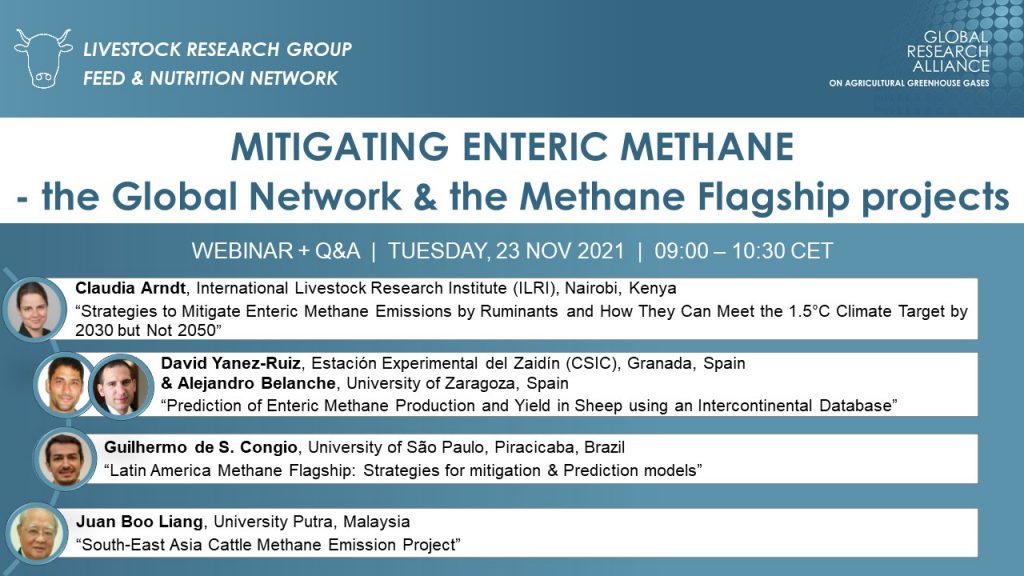
A recording of the November 2021 Feed & Nutrition Network Webinar, titled “Mitigating Enteric Methane – the Global Network & the Methane Flagship projects”, is now available to view.
This webinar session was facilitated by the FNN Network lead André Bannink and chaired by LRG co-Chair Sinead Waters.
It included presentations from Claudia Arndt (International Livestock Research Institute, Kenya), David Yanez-Ruiz (Estación Experimental del Zaidín (CSIC), Spain) and Alejandro Belanche (University of Zaragoza, Spain), Guilhermo de S. Congio (University of São Paulo, Brazil) and Juan Boo Liang (University Putra, Malaysia).
The agenda is shown below.
A recording of the November 2021 GRA COP26 side event titled “Contemplating the Co-Benefits: An exploration of their evidence-base to accelerate climate action”, is now available to view HERE.
This online event was hosted by Australia as Chair of the Global Research Alliance on Agricultural Greenhouse Gases and features a welcome and introduction from Professor Andrew Campbell, CEO ACIAR and Chair of the GRA. Hayden Montgomery, GRA Special Representative presents the work of the GRA as it relates to the topic of adaptation and mitigation co-benefits. Plus we hear from three speakers from across the globe working with the GRA to highlight the value that recognising co-benefits can bring.
Speakers:
Andrew Campbell, CEO ACIAR and GRA Chair
Hayden Montgomery, GRA Special Representative
Natalie Doran-Browne, University of Melbourne
Viviana Becerra Velásquez, INIA Chile
Cynthia Rosenzweig , Goddard Institute for Space Studies
The 2021 meeting of the Livestock Research Group was held over two online sessions on 6 – 7 October.
The meeting was attended by participants from 43 countries and four partner organisations. The meeting report and recordings of the online sessions are now available for download.