
We have a new report celebrating the highlights of the GRA , available to download and share. Check it out HERE.
World Bank
Latest News
The Global Research Alliance on Agricultural Greenhouse Gases (GRA) is very pleased to welcome El Salvador who joined us in June 2026 as our newest Member Country!
El Salvador’s participation in the GRA will be coordinated through the Ministry of Agriculture and Livestock (MAG), with its national focal point based at Centro Nacional de Tecnología Agropecuaria y Forestal (CENTA).
El Salvador recognises the importance of strengthening international cooperation, the exchange of scientific knowledge, and technological innovation aimed at reducing greenhouse gas emissions from the agricultural sector.
El Salvador considers participation in the Alliance to be a valuable opportunity to strengthen national capacities in research, mitigation, and adaptation to climate change, particularly in areas related to sustainable agriculture, soil management, resilient livestock systems, agroforestry systems, and food security.
Likewise, the country reaffirms its commitment to international climate action efforts, in line with the Paris Agreement and national priorities linked to sustainable development and climate resilience in the agricultural sector.
We warmly welcome El Salvador and look forward to their contributions to the GRA.
We are excited to announce the Round 7 recipients of Climate, Food and Farming – Global Research Alliance on Agricultural Greenhouse Gases Development Scholarships (CLIFF-GRADS). These PhD candidates from low- and middle-income countries have been selected from a large and highly competitive applicant pool, reflecting their outstanding qualifications and strong potential to advance agricultural climate research.
During 2026 and 2027, these fellows will undertake applied research focused on quantifying and mitigating agricultural greenhouse gas emissions, contributing to more sustainable food systems.
The 40 Round 7 CLIFF-GRADS fellows represent 21 countries from Asia, Africa, Latin America, and the Caribbean. They will carry out research placements at 33 host institutions worldwide.
CLIFF-GRADS offers short-term research placements of 4 to 6 months. These placements give early-career scientists access to specialized equipment, software, and international expertise not available at their home institutions. Fellows contribute to cutting-edge research in areas such as enteric methane, rice systems, soil emissions, and blue carbon ecosystems.
Please follow this LINK to learn about the scholars and research projects they’ll be part of.

July 2022
‘4 per 1000’ event: Agroforestry in Latin America & Caribbean
During this event, actors from the "4 per 1000" network working in Latin America and the Caribbean will present their approaches and share success stories in the area of agroforestry. Learn more HERE.
Find out more »
4p1000 virtual Fair: Regional Tour Africa
Join the “4 per 1000” Virtual Fair 2022 event "Healthy Soils for a Healthy Planet: Regional Tour Africa" on Thursday 28 July from 2pm. This event is organized by GIERI and Simpson Foundation. The event will be divided into two parts: 1) 14:00 - 14:45 CEST: French speaking Africa (stakeholders from this region will present their work in French) 2) 14:45 - 15:30 CEST: English speaking Africa (stakeholders from this region will present their work in English) There will be…
Find out more »August 2022
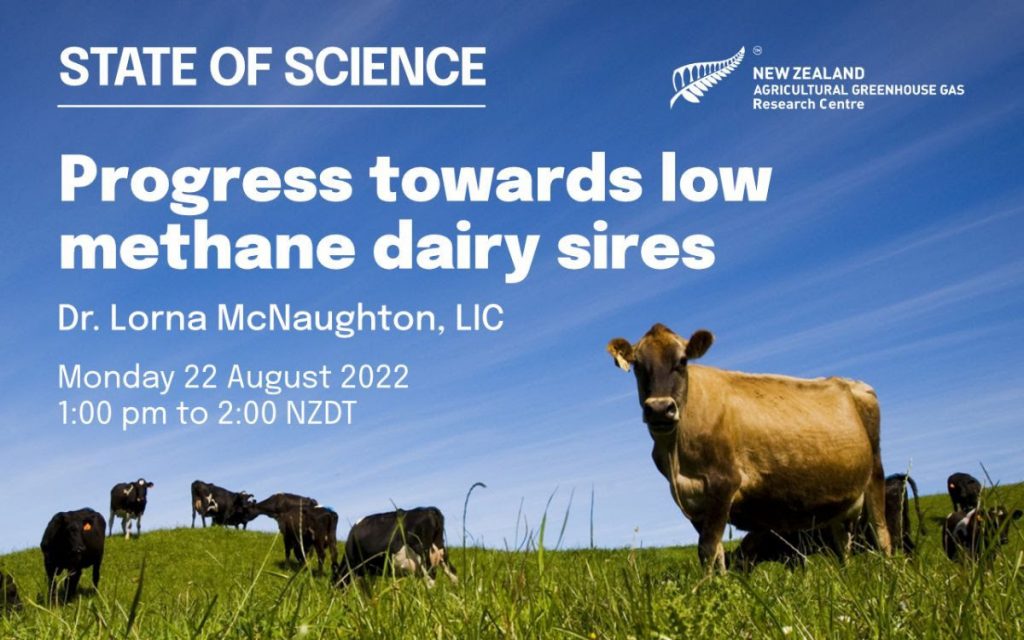
Webinar: Progress towards low methane dairy sires (NZ)
Join the NZAGRC on 22 August 2022 for their next State of Science webinar on their research into options for mitigating agricultural greenhouse gas emissions. With New Zealand sheep breeders now able to measure and rank their animals based on their methane emissions, scientists are now investigating whether the same can be achieved for cattle. Lorna McNaughton from Livestock Improvement Corporation (LIC) will provide an update on the progress in developing a breeding programme for low-emitting dairy cattle. This work…
Find out more »International Symposium on Climate-Resilient Agri-Environmental Systems (ISCRAES 2022)
This symposium will be held from 28-31 August, 2022 in Dublin, Ireland. The main theme of this symposium is “Implementing the New Green Deal: The Path Towards Sustainable Agriculture“, which refers mainly to European Green Deal having the opportunity and resources to achieve the primary objective of a sustainable Europe and planet by tackling the current major environmental, climate, and societal challenges facing by the world. Globally climate change is one of the most important issues facing the agricultural sectors…
Find out more »September 2022
Africa Green Revolution Forum (AGRF) 2022 Summit
The AGRF is the world’s premier forum for African agriculture, bringing together stakeholders in the agricultural landscape to take practical actions and share lessons that will move African agriculture forward. AGRF will host its 12th annual summit under the theme Grow, Nourish, Reward – Bold Actions for Resilient Food Systems from September 5 -9, 2022 in Kigali, Rwanda. Together with the Government of Rwanda and the AGRF partner’s group, the AGRF 2022 Summit will provide a platform to reflect on…
Find out more »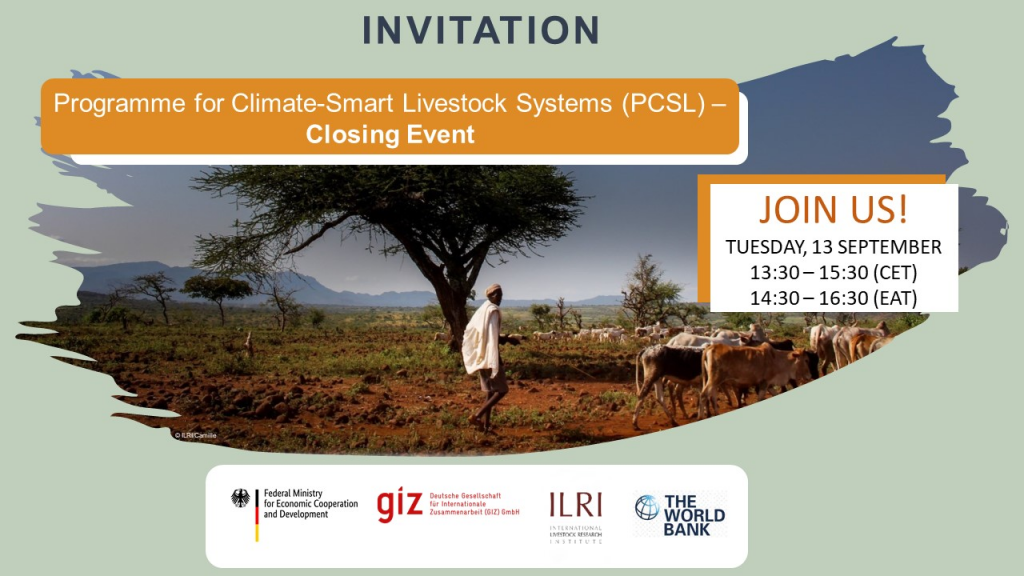
Programme for Climate-Smart Livestock Systems (PCSL): Closing Event
This event is organised by GIZ, the World Bank and the International Livestock Research Institute. "GIZ, the World Bank and the International Livestock Research Institute (ILRI) cordially invite you to a virtual closing event of the Programme for Climate-Smart Livestock Systems. After almost five years of implementation, we would like to share our key findings and lessons learned on supporting the development of climate-smart livestock systems in Africa. Experts in the field will showcase selected adaptation and mitigation measures and…
Find out more »
Biennial Africa Climate Smart Agriculture Stakeholders Conference
The 2022 edition of the Biennial Africa Climate Smart Agriculture Stakeholders Conference is scheduled for 14th to 16th of September 2022. This edition is providing opportunities for researchers, academicians and students to share their research findings. Further information can be found here.
Find out more »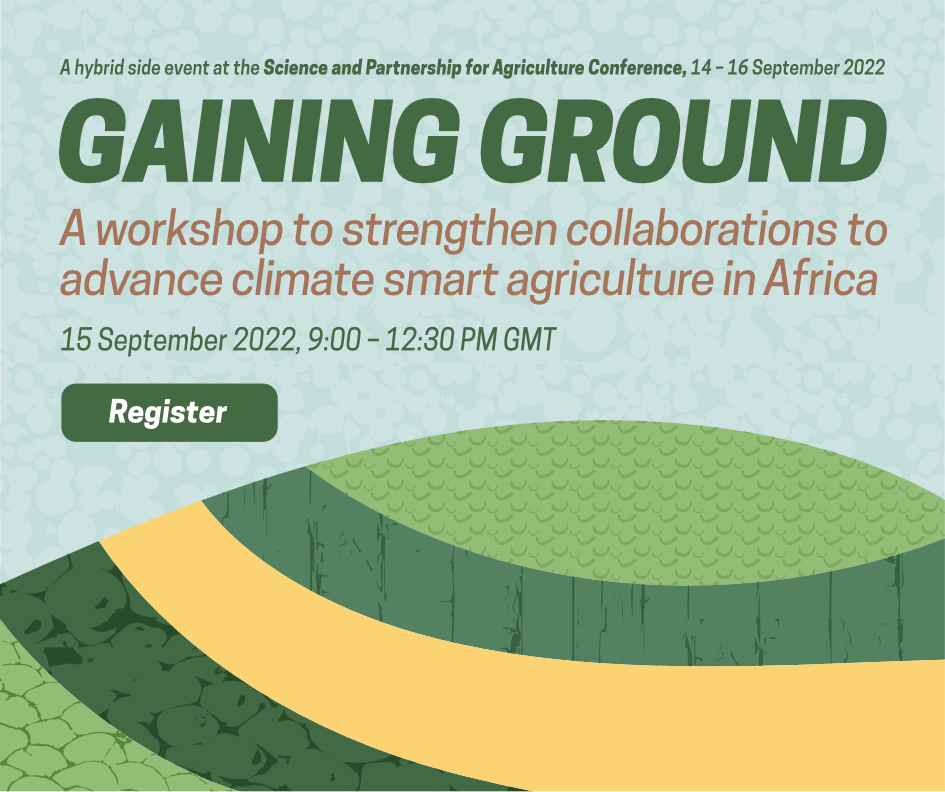
Gaining Ground: Workshop, Ghana & Virtual
Gaining ground: a workshop to strengthen collaborations to advance climate-smart agriculture As part of the GRA's continuing commitment to strengthening countries’ scientific capability and institutional capacity to increase productivity, enhance resilience and reduce greenhouse gas emissions, we are pleased to present “Gaining ground” - a workshop to strengthen collaborations to advance climate-smart agriculture (CSA). The workshop/side event will showcase science-based practices that illustrate pathways to climate-smart, low-emission agricultural development. The event will also offer an open platform to discuss how…
Find out more »EDF event: Growing Food in a Climate-Impacted World
Join Environmental Defense Fund (EDF) on 21 September in New York or virtually for this multi-part event. Full information and registration details HERE. To stabilize the climate and ensure a safe, vibrant future for us all, the world must rapidly cut climate pollution, draw down past carbon dioxide emissions and build resilience to the climate impacts that are already here. We can't achieve these goals without the food and agriculture sector. Environmental Defense Fund (EDF) will host a multi-part event…
Find out more »Webinar: Kohimarama – Indigenous Resilience to Climate Change in Mexico
The Kohimarama Initiative seeks to share stories of indigenous resilience and leadership in navigating climate change, seeking to empower indigenous youth to create their way to a sustainable future. Register HERE for the virtual workshop on climate change adaptation and mitigation in New Zealand and Mexico. Webinar Speakers: Professor. Aurora Xolalpa Aroche (Career Research Professor of UIMQRoo @Mayan University)Intercultural university model of working trough community diagnosis. A program where students return to their communities once a year to understand the…
Find out more »Webinar: Does methane from livestock matter?
TABLE will be hosting a series of 3 events this autumn leading up to COP27: What role for grazing ruminants in a 1.5°C world? on September 14 at 6pm BSTDoes methane from livestock matter? on September 28 at 5:30pm BSTPlating up the future of meat (date TBC) Join them as they explore questions regarding the evidence and values behind debates over livestock and climate change. For further information about Does methane from livestock matter? click HERE. Speakers include: Andy Reisinger (IPCC…
Find out more »October 2022
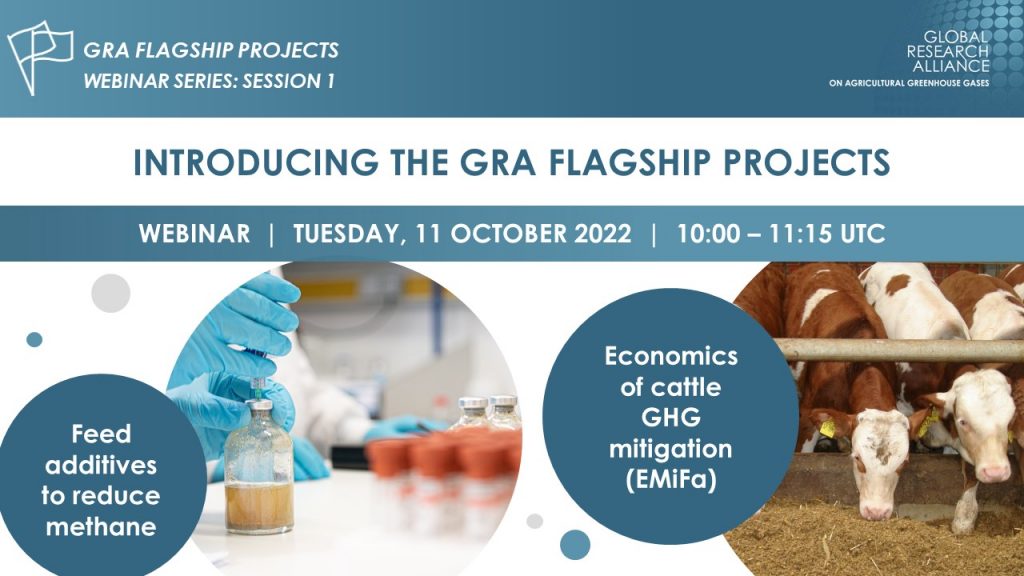
Webinar: Introducing the GRA Flagship Projects
Join the Global Research Alliance on Agricultural Greenhouse Gases (GRA) on Tuesday 11 October at 10am UTC for the first session in our Flagship Project webinar series. Learn more about two of the current GRA Flagship Projects, their key partners and how YOU could get involved. GRA Flagship Projects develop new knowledge to better understand agricultural greenhouse gases, have global relevance and applicability and generate high scientific impact. This session will introduce the following two Flagship Projects: Technical guidelines to…
Find out more »